02 December 2011

11 November 2011 – Bairnsdale, Mallacoota, Home.

Sorry for the late . . . . . . .  . make that ‘very late’, update of the blog.  We are now at home, and have been for three weeks.
We spent Melbourne Cup day at the Bairnsdale racecourse and, firstly, had a really enjoyable time and secondly, were amazed by the size of the crowd.  Also of interest was the fashions worn by the different age groups. I assume that every Melbourne Cup Day race meeting holds a series of “Fashion Parades” and that most are conducted more in merriment and fun than in any seriousness.  So it was at Bairnsdale.
The clothes chosen by the majority of younger men were clearly from the cheaper racks, and those of the young ladies were selected by the amount of flesh that could be exposed (I don’t have any objection to this!).  As the people within the main category ascended to dais, it was obvious that a lot more money had been spent, and a huge increase in style was apparent from both genders.
Race Day crowd at Bairnsdale

We were fascinated to see just how many race meetings were available for betting.  Every major city and almost every provincial town had races that were being displayed upon the huge trackside screen.
We lost $70 on the Cup – although not to worry, we’ll just sell one of the kids into bondage.
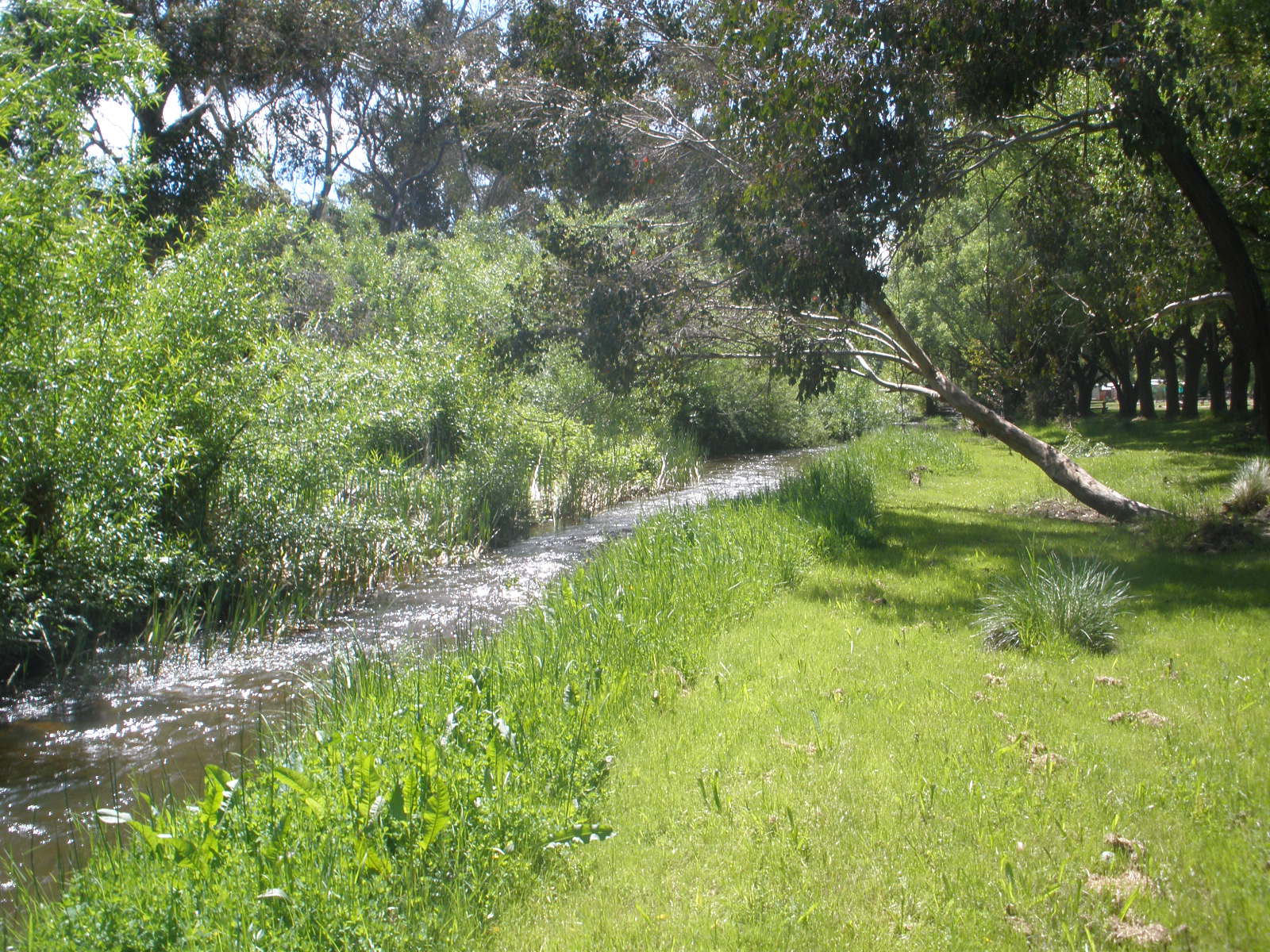
Prior to leaving Bairnsdale, we took the opportunity to drive up to Omeo and revisit some old memories. 33 years ago we took the kids to Omeo, and other Gippsland places,  for their first big camping trip. The campground has changed in many ways, but is still quite recognizable as the one we stayed at. Where once there was a fairly wide and shallow river running beside the park, it has now become so overgrown with weeds that access to the water is almost impossible. Another change is the introduction of power and water poles to each site such that it now resembles every other caravan park. Gone is the rustic rural campground where there were no powered sites and water was carried from the communal tap.
 Omeo Caravan Park
 The Mighty River (now but an overgrown shadow of its former glory)
Shirl finally got a close-up photo of an Echidna
From Bairnsdale we moved to Mallacoota where, after booking into our chosen park, we did a quick drive around to discover the ‘lay of the land’. What we found must rate as one of the largest caravan parks in Australia. This park extends around the foreshore of the entire Mallacoota village – it has numerous ‘personal jetties’ that are rented out to those who are occupying a park site.  Mallacoota Inlet is quite spectacular in appearance in that it has many small sand based islands, together with larger vegetated ones. As low tide arrives, many sand banks are exposed which explains why the place is a mecca for the Flathead and Whiting fisherfolk.
I went out on a charter boat one day and was quite astounded by the vast sea grass beds and the relative ease of getting a few flathead (amazing how easy thing become when you do them the correct way!).  If you have a boat, this is a truly outstanding water way.
This Park extends for .................. ever.

On our last day we drove up to Gypsy Point (about 20km) and went on an eco style boat trip. The ‘Capt” was quite astounding in that he could locate tiny birds and water dragons from far greater distances than we could see. We had trouble seeing the log he was pointing to, let alone the 2 inch long dragon camouflaged upon it. Perhaps the biggest ‘party trick’ was where he fed the sea eagles – spotted a pair up in a dead tree, motored over toward them, grabbed a dead fish from a bucket, grabbed a BIG syringe and began injecting the fish.  When asked by a passenger “what are you injecting into it?”, he replied “Heroin, it keeps them coming back!”.  The reality is that he was injecting air into the fish so that it would better float.
The birds began circling above the boat until he tossed the fish about 5 metres away. The birds were swooping before the fish hit the water, and their attack had pinpoint accuracy and was awesomely spectacular. Something to remember.
 They start here!
and they hit with massive speed, accuracy, and vigour
Thursday was moving day – hitched up in pouring rain, drove off in pouring rain, continued driving in pouring rain until we were we up the climb towards Bombala. We stopped for the night at Nimmitabel (at 1100 metres altitude) – not the warmest location in Australia.  The campground is a self managed council one where you drive in, set up, ring a osted number and a guy pops over to give you the special key code to access the secure water key.
Nimmitabel is a bit sad really. Here we have a very old Aussie town that has some real history, but modern life is killing it. Even the pub has closed, and the one remaining club closes at 6:00pm – no meals!  Apart from having a great (make that a real great) bakery, the town has very little business remaining.
The following morning, Friday 11th, we arrived home after 8 months on the road.
The work of unloading and re-establishing life in a big house has now started.
Thanks to all those who have followed the blog – I’ll do one more post of the basic stats from our trip this year, then it’ll be bye from me, and bye from her, until next March/April when we head off again.

29 October 2011

30 October 2011 – Geelong, Mornington, Port Albert, Bairnsdale.

One of the odd little things about being ‘on the road’ is that you are forced into purchasing a number of products that you normally wouldn’t.  For example, different brands of shower body wash. We all have our favourites: we buy them month after month, year after year, and unless some major event occurs that forces us to change, we will always buy the same brand.  Well, the bad news is that when you go caravanning every brand of, . . . . . well, everything, is not available in every town.
Thus I need to ask: have you had a look, a really serious look at the current range of shower body shampoos?  It’s like looking at a fruit shop product list – ‘watermelon & lime’, Shea Butter & Mango’ (what is Shea Butter?), ‘Quince & Celery’, or ‘Vanilla & Cinnamon with hints of Cumin’.
Shirl & I needed a new thingo of body shampoo, so during our next shopping spree, we paused at the 23 shelves of such things. Confused by the vast array of options, we drew upon our prolific wine tasting experience to assist our deliberations.
As I tested the first, I noted to Shirl that it had a decided after feel of mango on the neck, with a soft fruity berry remnant in the lower stomach area, combined with a hint of passionfruit under the jaw. Shirl replied that the one she was testing had a soft, almost gentle feel of spice upon her breasts, coupled with the merest hint of citrus behind her knees. I selected the next bottle and liberally applied it and discovered that it had the most delightful lingering feel of fresh watermelon to my face, and simultaneously offering an almost deep and ephemeral long lasting infusion of Shea butter to the groin area (I simply must do more research on this Shea Butter).
We were quite lucky in that we had just agreed on a lovely little bottle of Cumquat & Lychee, with an infusion of crushed pomegranate seed exfoliation gems, when we realised that a number of the staff at the Geelong branch of Coles were taking an inordinate degree of interest in us. We moved on to another aisle!
Geelong is like so many former industrial cities as they drive themselves forward from their grimy history into a great rebirth.  For Geelong, this means that the former wool sales, transport, and mills have elegantly transmogrified into art centres, museums, and education facilities.
No boring wharf bollards at Geelong.

We thoroughly enjoyed the time we spent at the Wool Museum which covered the entire production from the sheep husbandry, types, and development, through the shearing and culminated in the transformation from shorn wool to finished product.
The second museum that we visited was of more interest to me than to Shirl – the Ford Museum.
For the trivia buffs, Ford’s sponsorship of Geelong AFL team is the World record for a single sporting team – 1935 or 76 years. Some vehicles of interest that are on display include the very first utility (1934 Ford), the original Ford Territory mock-up on a Falcon chassis, and the only car that Craig Lowndes has ever owned: a Ford Cortina.
In its day, the World's fastest 4 door sedan.

In its day, one of the World's slowest sedans!

We left Ocean Grove and headed to Mornington via the Queenscliff to Sorrento ferry.
Exiting the ferry

I suppose one of the oddest things that we have noticed here are the beaches. There are absolutely no waves; none. Maybe this is a caused by the extremely shallow water in that you need to wade out for a very great distance before your bum gets wet.  This makes it really good for the little kids who splash and play with a high level of safety.  Meanwhile, many of the young adult couples wade out to groin level and just stand there and cuddle - - - yep, cuddle.  Is this some form of Melbournian mating ritual?  Perhaps some strange public accepted form of foreplay. Or simply a sharing of body warmth.
Should anyone be visiting the Melbourne area, we must recommend, no, make that most highly recommend that you take the time to spend at least a full day in the Mount Dandenong area. Our visit coincided with a quirk of weather that provided the most impressive backdrop to the mountain.  It had rained the night before, and the morning was very light misty rain. As we climbed the mountain, we drove into thick fog and mist which set off the rain forest clad terrain to perfect effect.  The town of Olinda almost consumed our kids entire inheritance as Shirl flitted from shop to shop looking at the most diverse range of craft and oddities. Lunch was also pretty special.
After lunch my wallet and I decided that we needed respite from the retail opportunities, and thus, found our way to the “The William Rickart Sanctuary”.  In 1934 William purchased a bush block in the rain forest, and set about creating ceramic statues and attaching them to trees, stumps, or left them free standing within the forest. The results are outstanding.


what a backdrop.

Fired up by this cultural experience, we pushed on to the National Rhododendron Gardens where we were entranced and gob-smacked by the extensive variety of rhododendrons, azaleas and, other plants from the same genus. Our timing was almost spot-on as the flowering was just past its prime – 2 weeks earlier would’ve been perfect. Maybe 10 to 20% of the blooms were starting to wither, but the broad effect was still stunning. Rather than walk, we chose to use the small bus to get around. This proved to be a wise decision as the gardens range in altitude of 150 metres and the paths measure just over 5 kilometres.
Rhodedendrons

No caption needed


Another must see on Mornington Peninsula is Point Nepean, or the eastern headland of Port Phillip Bay.  Until a few years ago the entire headland was restricted because of the presence of defence activities, plus the quarantine station. Both are now closed, and the National Parks have taken control.

Of trivial interest is that the first allied shot of WW1 was fired from the big gun on the point. Word was received that war had been declared just as a German registered ship was about to exit the bay, so it was signalled to go about and when it continued steaming towards open water, a shot was fired across its bows. It turned about. Even more amazing is that this very same gun fired the first allied shot of WW2, and in very similar circumstances. It was the only times that the gun was ever fired.
The quarantine station is an eye opener. We found it remarkable that even in such a place, they needed to maintain the separation of the classes – first class, second class, and steerage were provided different accommodation(s).  This is even more fascinating when you consider that there were 3 types of quarantine: those who were definitely infected, those who were under watch because the doctors weren’t sure, and those who were free from infection. Thus 9 groups had to be fed, clothed, and housed.

The disinfection unit - everything went through this.

Hospital Unit 3

On our way back to the van, we paused at the Maze Gardens – two traditional hedge mazes, a great circular rose maze, and a delightfully perfumed lavender maze. I bet you’re waiting for me to say it was amazing! The truly amazing thing is that Shirl, who gets lost going to the ensuite, took to this fun place with relish. She couldn’t find her way out of course, but she giggled like a school girl and really enjoyed herself. 

Hedge Maze

Shirl conquers the Lavender

Ian lays waste to the rose maze
We really liked Mornington and have now added it on our list of places to which we will return.
Beach huts at Dromana
Thursday (27th) and we set off for Port Albert which is one of the oldest ports in Victoria. We chose this tiny little village to seek isolation from the hordes of “Long Weekend, Family Getaways” (Melbourne Cup on Tuesday = unofficial long weekend).  Upon arriving we found that this weekend is the annual ‘Snapperfest’ fishing tournament, so our isolation is not quite so.

Our nearest neighbour at Port Albert
Inland from Port Albert is the Tarra Valley and the Tarra Bulga National Park. Thirty three years ago we and our 4 boys camped at a caravan park located well up into the valley. We also visited the NP both in daylight and at night where we very quietly waited for the possums to come out and timidly be hand fed.  The greatest pity is that the boys remember very little of the trip – waste of damn time taking kids anywhere, bah humbug!


Tarra Bulga Nat Park

Entrance / Exit Tarra Bulga Nat Pk

19 October 2011

October 2011 - Beachport, Horsham, Daylesford, Ocean Grove

The process of moving from one location to the next is, at first somewhat haphazard. Who does, or should do the jockey wheel? Or the utilities hoses? Or the wheel chocks?
It soon works itself out – Shirl does what she wants, and I do the rest!  I guess I’ll pay dearly for that little comment. 
In truth, Shirl packs and secures the inside stuff, while I do all the outside things which includes installing the towing mirrors and tow ball on the car. At some stage Shirl calls me to close the roof hatches and wind down the TV aerial (she can’t reach ‘em). Once all is ready, I jump in Tom (Cruiser) to reverse onto the ball while Shirl guides me. We then share, and counter-check each other as we do the chains and other connections between the van and tug.
Last thing is for Shirl to disconnect the power cord, and switch the fridge to 12Volt (we leave it as last thing because it (a) draws a fair bit of battery power, (b) 12v is not as efficient as 240v .
All this is completed normally within 30 minutes, or less if we’re in a hurry.
Once we’re on the road, the distance that we cover each day varies quite a bit. Our preferred range is somewhere between 250 and 400 km, but like all rules of thumb, this gets amended as needs be. For instance, when crossing the Barkley Tableland from Qld to/from NT the distances between fuel stops is not ideal, particularly when one of those stops is exorbitantly expensive. Thus 470 km is required. Once we’re on the coast (any coast), we may well reduce our daily range to slip into somewhere we really want to explore.
This distance thing is a nice little transition into where we went after Adelaide. With the rain falling, and the wind blowing we ventured forth from Christies Beach to traverse the suburbs of Adelaide, then up, and up, and up the seemingly never ending climb along the road to Murray Bridge. It was approx 20km in 2nd gear of either climbing, or descending before we got to flat country.  From Tailem Bend the road becomes a little bouncy as you run beside the Coorong (magnificent to see it full to overflowing after so many years of drought). Finally after 420 km we arrived at Beachport which is a quite small lobster village on the Limestone Coast. The village is dominated by its 772 metre jetty and is perhaps most known for its “Pool of Siloam” which is a pool of water 7 times as salty as the ocean.
 Beachport Jetty and Rivoli Bay.

The Jetty
I had two great aims at Beachport – firstly, to sit on the jetty and reel in multiple fish. And, secondly, I really wanted to float in the “Pool of Siloam”.  You see, I must admit that I cannot float. I jump in the water, lift my legs, gently kicking, arms spread wide and waving serenely, and promptly sink.  I feel that should I ever take up SCUBA diving, I would excel at the diving bit, but would perhaps struggle somewhat on the surfacing stage.
I never got to achieve either aim because the weather was atrocious – wind so strong that should I have attempted to cast a line, it would’ve landed in Tasmania, perhaps even Antarctica. Needless to say, the thought of getting my kit off to try for a short float was not too good either. We did enjoy the area as it is very picturesque but it was a pity that the South East of Australia decided to have a cold and windy snap at that particular time.
We did manage to do a little local sightseeing and found what must be one of Australia’s greatest feats of “Up yours”.  Murray McCourt was a farmer who had a large portion of his land rendered useless by swamp. Murray lobbied the local council, the state Government, and even the town drunk to get a channel dug through the mountain that was causing the problem. Everyone told him that it was too hard: it couldn’t be done: and that he was dreamin’. Murray said ‘bugger ya all’ and he and one of his farm hands dug a 1 km long channel, which is 28 metres deep (93 feet for all you old guys) and is 1 metre wide at the bottom, extending to 20 metres at the top. The interesting thing is that he only used a D7 dozer, two earth moving dozer attachments, and a home modified dragline to complete the Woakwine Cutting in 3 years. He showed ‘em.

The Cutting - through rock, not dirt.

 We also go to see a wind farm of 135 units at Millicent. This farm provides 1/8th of South Australia’s power needs and is truly amazing to see all those blades turning at what appears to be a co-ordinated rate. It’s worth noting that they are preparing to install an additional 180 units in the surrounding area.
After 5 nights we pushed on into Victoria – you may think that the transition into daylight saving time is a tad confusing, well think about us as we moved from SA time into Vic time (forward ½ hour), then the next day go forward (or was it backward?) 1 hour for DST. Also consider that we have a part of our family in Qld, which still remains in the dark ages and thus causes us to run a clock on Pre-Columbian time.
As we traversed the Glenelg Highway we marvelled at just how good the country looked. Everywhere we looked we seen sheep and every one of them in prime condition as they fed on awesome pastures.  After a short stop at Hamilton (now on our list of places that we intend to return to), we made our way to Horsham where we set up on the banks of the Wimmera River.  This was to be our base camp as we explored the Western Victorian wheat belt as well as the Grampians.
First exploratory trip was out though Nhill to Jeparit, Warracknabeal, Minyip and back. Nhill was a disappointment because it is in real need of a good lick of paint and a real dose of civic pride – a once great rural town gently fading into the past.  Jeparit was similarly focussed on rotting away without anyone seeming to care.  This is a pity, given its claim to fame. Jeparit was the birthplace of Robert Menzies, our longest serving Prime Minister, and regardless of your politics of choice, we do owe some form of respect for those who have achieved the ultimate leadership of the Country.
The birthplace of Bob Menzies - note the public conveniences in the background.

Warracknabeal was a pleasant surprise because of its size.  A four pub town is one that deserves a degree of respect – although, one of them is for sale for $680,000.  Is anyone in need of a home with lots of bedrooms for guests, plus a really large kitchen and lounge?  It also has a great bar; if you were so inclined, you could entertain what would become many friends.
Pub for Sale

We noted that Kiwis are banned from Warracknabeal. The local council are sick of repairing the statues that they have in the middle of the round-a-bouts on the main street.
Statues in middle of Round-a-bout
Those of you who were of TV viewing age about 20 years ago would have seen many views of Minyip as it was shown as “Coopers Crossing” for the Flying Doctors television series. It still looks the same.
The next day we headed off to Stawell where we stood on the ground where the Stawell Gift foot race is held. The ‘Gift Museum’ is something that can occupy your thoughts for quite some time.  It was fascinating to compare the actual shoes worn by the winners of 80, or even 30 years ago with those worn in current times. What times would the old timers have run if they were availed of the technology of today?
Stawell Town Hall - Figures at base of clock tower do a mining action every hour
After Stawell we headed to Ararat and we delighted by what we found – a thriving town that is clearly doing well. One of the places we toured at Ararat was the old Gaol, now known as “J Ward”.  It only operated as a prison for 20 or so years, and then became the Victorian Prison for the Criminally Insane for the next 100 years.  It is quite horrendous to comprehend that we, as a supposed humane and civilised society treated people like this as recently as the 1990s.  A second institution that Ararat hosted for even longer is “Aradale”, the Victorian Lunatic Asylum. Started in the 1860s, closed in the early 1990s.  The longest serving inmate entered via the gates in 1932, and left in a coffin in 1995 – 63 years in an insane asylum. He was 107 years old!
Ararat Town Hall - ain't it a doozy?

From Horsham we towed the van across to Daylesford which is located about halfway between Castlemaine and Ballarat, and sits right on top of the Great Divide.  The area is known as Australia’s spa capital. 
I’ve oft made the boast that there isn’t a hill that I can’t climb whilst riding my recumbent trike – I now need to eat my words after seeing the roads within Daylesford and Hepburn Springs.  I am of the view that it isn’t the water that keeps the locals healthy: it’s the exercise that they get just going to and from their daily activities.
Again we completed a few day trips. The first was a loop that took in Clunes (something wrong there as they have 1300 citizens, 4 churches, and only 2 pubs), Talbot, Maryborough (Must have the most impressive railway station ever built outside our capital cities), Maldon (sadly going downhill from what it was when we were last there 16 years ago), and finally Castlemaine.
Maryborough Railway Station - It is huge!
Our second day trip took us up to the famous hanging rock of movie fame. I warned Shirl not to go up there: I’m still tossing up whether to start searching for her!  The next stop from the ‘Rock’ was Mount Macedon where a huge cross was built as a memorial to those killed in the Great War. We’ve seen many memorials to our war dead but this one was particularly moving – it just grabs your heart and head and turns them towards why it was built. Given that the Mountain is just on 1000 metres altitude, the memorial is visible for many kilometres.
Just wander up this way to Hanging Rock
I think this is where I lost Shirl

A particularly great memorial

The weather at Daylesford was ..... ..... ....   .... bloody cold. The caravan park reception office has a photo taken Oct 16th 2010 that shows the park under inches of snow. I understand that this year it was way too cold for snow to fall.  One of the oddities of caravan air-conditioners is that they won’t work beyond certain temperatures – think about that, your air conditioner won’t heat if the air is too cold, nor will it cool if it is too hot!  At Daylesford, our unit wouldn’t work each morning so we needed to resort to our little electric fan heater to heat the van enough so that the air con would turn on.
We are now on The Bellarine at Ocean Grove and just across the river from Barwon Heads (Sea Change TV series location).     
The best known town around here is Queenscliff. Almost every tourist brochure or publicity document includes a photo of at least one of the Queenscliff pubs. Many old shops and public buildings dominate the streets, as do a number of magnificent old mansions (mostly converted to B&Bs). Like many places around Oz, there is a tourist steam train that runs to another town called Drysdale. What makes this one special is the range of special trains they operate – each week they do a ‘Jazz’ train that includes a feed and some really good jazz musicians. They also have the best Thomas the Tank engine that we’ve found. Not only Thomas, but Henry and ... ... ... the other ones whose names just escape me! Each weekend they do an entire show with a full PA system and some quite talented kids entertainers. Each kid is made feel very special.


We drove over to Torquay yesterday and were quite amazed to see the huge number of surfers in the water. Of course they all were wearing wet-suits, but their hands and faces must have frozen.

Torquay main beach

The Famous Bells Beach

We then pushed on and drove the Great Ocean Road (well, ya just gotta’, dont’cha?), as far as Lorne. Its 16 years since we’ve been through here and the growth of Lorne just blew us away. What was once a pleasant seaside holiday town is fast becoming an upmarket yuppy-ville with the main street dominated by apartments.  Perhaps one of the best indicators of Lorne’s push upwards was the sculpture exhibition that they held on the beachside – this one is for sale @ nearly $100,000!

And this one is $335,000.  Maybe you should buy a pair so they will offer a balance to your entry (might as well, since your bank account won’t be balanced).


we're now less than 4 weeks from home, and looking forward to seeing the family. After a few more days here, we're heading across on the ferry to Mornington.

29 September 2011

28th September 2011 - On our way to Beachport.

This post is to fix up an omission from a previous post.
Our stop-over at Woomera had a purpose other than just somewhere to park for the night.
Way back in the early 50s, a surveyor by the name of Len Beadell was tasked with selecting the site for the British Government to undertake some nuclear testing. It was Len who chose the site of Woomera. He was then asked to find a route through the inland such that when they fired the rockets, they wouldn’t go too close to any towns or villages.
Okay, it’s time to get your map out because Len plotted a route from Woomera to the West Coast just north of Port Hedland, thus becoming the longest possible human habitation free land route in the World.  He then needed to build roads to access this route at many locations. These “roads” were really just tracks that Len and his team of 6, with a bulldozer, a grader, a stores 6x6 truck, and Len’s Land Drover used to bash through the scrub.
These roads still exist! Gunbarrel Highway (Len liked straight roads), Connie Sue Highway (Len’s Daughter), Anne Beadell Highway (his wife), plus many others.
Beadell was Australia’s last true explorer. If you get a chance to listen to his CD, grab it with great haste because he is also a very laconic and dry humorist.
Our visit was so that we could pay respects at Len’s grave in the Woomera cemetery.  

27th September 2011 - Christies Beach Adelaide

South Australia seems to be undergoing a housing explosion, and not just small workers cottages, but quite large McMansions.  The extent of this boom became very evident when we arrived at Wallaroo. Here is a town of approx 2500 good folk and now has a large marina and canal estate with the accompanying extended housing area which is full of large McMansions that would enhance the best new suburbs of our larger cities. Clearly the obvious question is “Who the hell has bought these”.

Wallaroo, Kadina & Moonta are known as the copper triangle or “Copper Coast” because in the 1860s that precious metal was discovered on a property where Kadina now stands. Wallaroo was created as a shipping port and was, for some 60 years, Sth Aust 2nd largest port. Soon after, a second mine was established at Moonta thus for a while, making the area the World’s largest copper supplier.
What remains are three towns just 12 km from each other, and each full of old stone buildings both commercial and housing, that are just so picture perfect.

While the Copper Coast was magic to look at, it did have a significant weakness – the bloody weather.  What happened to Spring? Why was the wind so constantly blowing from the Antarctic?  For the first time in 12 months I had to wear long trousers.
After four quite busy days, we hitched up and moved 160km further south to Edithburgh at the ‘heel’ of Yorke Peninsular. Here we had a thriving metropolis of 400 people in a quaint little historic port town that was once one of Australia’s largest grain exporters. It’s once great jetty is now used by fisherfolk.  It proved to be an almost ideal base for us to explore this now quiet and interesting peninsular. While at Edithburgh we took the opportunity to do the 80km trip across to the Innes National Park located on the ‘toe’ of the Yorke.  We found an absolute gem. There is only one small community at Marion Bay, and then an awesome coast with wild seas, great cliffs, shipwrecks, amazing wildflowers, and so many baby emus that we lost count. Once more we discovered a lost industry. 90% of Australia’s gypsum used to be mined around Marion Bay, but the plunder is now completed and nature is recapturing it for itself.  And, yes, we also found a new plush housing estate on the Marion headland with homes of great size and splendour – who buys these things?


After 9 days on the peninsula, we hitched up and moved across to the south of Adelaide. It seems odd that it is only 50km across the water of the Spencers Gulf, but 280km by road. Initially the road was fairly bumpy and undulating making things a bit slow, but after we went around the top and headed south, things changed to ‘great’. Flat, straight, wide, all the way into Adelaide.
Our park is located right on Christies Beach about 25 km south of the CBD, but only 2km from a huge shopping mall (and 10km from McLaren Vale wineries).
We went to the movies on our first day here, and seen “Cowboys and Aliens” which was quite enjoyable – never gonna win any awards, but great light entertainment. Day two was washing day for Shirl, while I took ‘Tom’ Cruiser up to the local Toyota dealer for a service.
On the Saturday, we travelled down to Goolwa which is where the Murray River joins the sea. What a great little town (and new large, expensive housing estate) with lots of old buildings and a long history.  A few years ago there was a long series of court actions aimed at preventing a bridge being built across to Hindmarsh Island, and thus impinging upon the site of “secret women’s business” for the local indigenous population. The bridge was eventually built, and if there were any such sites, they would now be buried under ...... you guessed it, a huge – make that bloody huge – marina and canal estate that, judging by the size of the boats, and the brands of the cars, is a long way from a working class area.
 Murray Mouth - behind the 4x4s (bet they'll have a rust problem)


I guess they don't want people to go to the beach!
It was really special to stand about 150 metres away on the area directly opposite the mouth of the Murray and watch the waves break on the beach, followed by the water surging in and out the mouth. A feeling of awe overcame us as we looked at what was the final fling of this great waterway, as it completed its journey from the slopes of Mt Kosciusko. Although if you sought to trace the waters greatest length, you would find that you needed to go to far off Queensland.
After we returned to town and had a bite to eat, we followed the other bank of the river down to the barrages which are 8 km upstream from the mouth. These are really fascinating in how they are used to stop the salt water flowing upriver.  In the 1930s, after 100 years of agriculture along the Murray, the flow at the mouth had dropped such that salt water now spread some 250 kilometres upstream and made the river useless for farming. Thus a solution was needed. The barrages are really a very low dam across the river that holds the fresh water at just a small, tiny, wee bit above sea level, and as either salt or fresh rises or falls, they add or remove big concrete panels to keep it just right. It’s ironic that the solution fixed the squeaky wheel, and allowed even greater plunder of the river’s resources such that even after the floods of the last two years, only 27% of the water reaches the mouth.
Standing on a Barrage in the middle of the Murray - this is one of the concrete blocks they drop into the barrage (see slot behind it.)
Next stop was Victor Harbour where we had hoped to go for a ride on the horse drawn tram along the 600 metre wooden causeway to Granite Island. However, it was out of use while they were doing some major upgrade works – bugger.  Not to be beaten, we went to the whale museum instead.
Yet again we were totally discombobulated by the plethora of new expensive homes being built.  We know why the Queenslanders are having trouble finding tradesmen to rebuild things after the floods and cyclones – they’re all in South Oz building great big McMansions around Marinas!
As we drove ‘home’ via the long scenic route that included Cape Jervois, we commented that the Fleurieu Peninsula is indeed, a damn fine bit of beautiful country.
Sunday. What can you do to keep yourself entertained on a Sunday?  Well, if you’re only 10km away from McLaren Vale wine district, you could go there. So we did.
Great wines, great lunch: all round great day.
Yesterday, Monday was our “Adelaide” day where we drove into town via a convoluted criss-cross route. The homes in the older suburbs are truly magnificent with their stone walls and slate roofs. Rather than knock ‘em down and rebuild a modern disaster, they have retained and maintained whole suburbs of these glorious homes. And, when you go to the old working class suburbs, you find the same approach. Street after street of stone built cottages, and each of them in good knick.
Another glorious feature in Adelaide (actually all of South Aust), is the vast number of 100 year old stone pubs. Everyone one of them would be a great place to have a beer, or four. Perhaps one of the better examples is found at Largs Pier – see photo.
Largs Pier Pub