03 July 2012

3rd July 2012 – Broome.

It’s strange how when you think that you have seen the best beach or mountain, lake or gorge, nature grabs your values and throws them in your blender of emotions. This was certainly the case when after deciding that gorges just didn’t get better than that at Katherine, we experienced the Ord River.
The Ord (plus a number of smaller rivers) feed into Lake Argyle, from which a number of overflow outlets plus the main Ord flow down to the diversion dam at Kununurra. From here, water for the East Kimberley irrigation scheme is diverted into a maze of channels.
Lake Argyle is Australia’s 2nd largest, after Tasmania’s Lake Gordon, man-made lake
and is equivalent to 18 Sydney Harbours (Yep, it’s really damn huge). During the ‘wet’ season, the daily inflow to the dam would supply Australia’s entire annual water consumption!
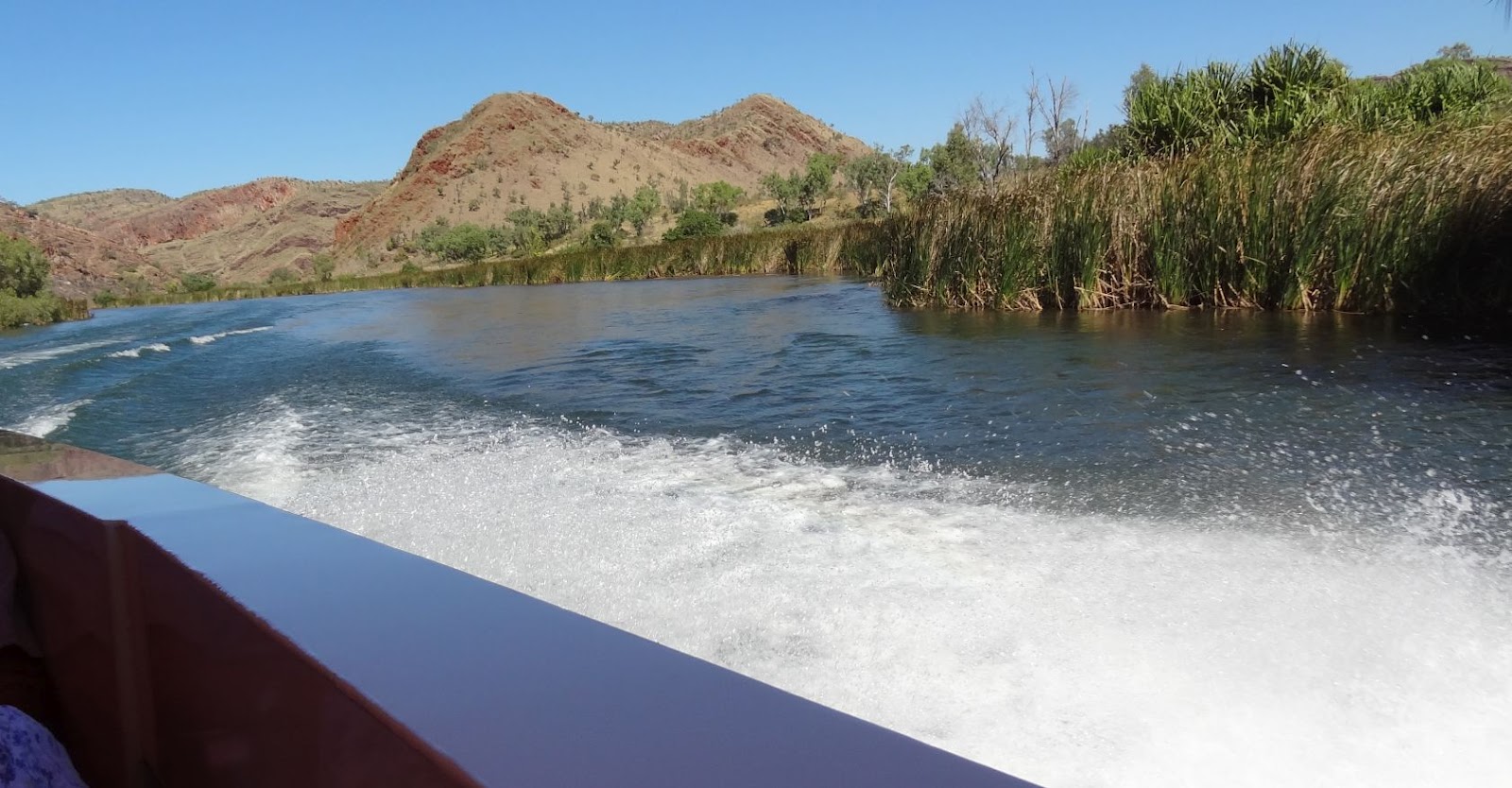
We took the opportunity to do a boat trip from the main dam, down the Ord River for 23km, until it hits the backwaters of the diversion dam, then turned around and returned to the dam. This is where our dilemma began.
Ultimately we decided that the Katherine and the Ord are, in their own way supreme equals. The Katherine Gorge is the epitome of serene tranquillity, where mirror smooth waters invoke calmness.  The Ord generates animalistic exhilaration and excitement as you hurtle through a twisting and turbulent rapid strewn rugged primeval and stunning landscape of spectacular high cliffs.
Gentle sections

Followed by more interesting sections
and all at exciting speeds
Of course the boat that we were on may have had some impact on our thoughts – it held 37 passengers, and had over 1000 horsepower pushing it down the river at 60kph. While the initial run down the river was great, the return trip against the river flow was a real adrenaline rush.
 It looks docile .... until it gets angry
What an interesting place is Kununurra. Where we expected to find somewhat flat or at best slightly undulating country, we found some stunning rugged ranges and gorges to the south.
It seems a wee bit odd to realise that the location of Kununurra was selected because of the vast alluvial plains that lay to the immediate north. This smooth endless flat land extends from the town, all the way to the coast and quite importantly as it drops only 42 metres in more than 200 km.
With Lake Argyle providing a totally reliable water supply, plus the enormous flat plain with a constant fall per km and you have the perfect components of the World’s largest gravity fed irrigation area.
Unfortunately, our greatest feral pest, the Cane Toad has found its way from Queensland, across Northern Territory and is now in West Oz. The first area it has got to is the above irrigation area, and it acts as if it has found heaven. To learn a bit about this pest, I went out one night to work with the ‘Toad Busters’ who catch (and exterminate) toads. It was a surprise to find that bare hands are the tool of choice – one young girl even used a technique of grabbing them by the snout! No fear of poison glands here.
The Toad Mobile - goes, or floats everywhere

Twelve kilometres downstream from Kununurra is Ivanhoe Crossing; another of those famous barramundi fishing spots that have achieved iconic status. Due to the floods and unusually late rains, the crossing has been closed to traffic for the last two years. However, this doesn’t stop those who seek the thrill of catching a really big fish. Interesting to note that last week, a few km upstream a 4+ metre croc was caught!
Note how deep and fast flowing it is - and big crocs live here!

Talking of crocs, (you like that little segue?), we did a 200km return day trip to Wyndham and found one of the best lookouts you could imagine (okay, that may be a bit of hyperbole, but it is really good). Wyndham faces onto the Cambridge Gulf, which in turn is fed by 5 rivers and thus the lookout is so called “Five Rivers”. It was a little disappointing to find that we had arrived at low tide, and with a tidal range of 10 metres, that is very low. The other thing the town has is a croc farm – they capture rogue beasts that are harassing various communities or towns and then breed from them. The young are ‘farmed’ at about 2 metres long (two to three years) and the entire output goes to France for use in high end products.


The Egg collector and his 'Cone of Silence' - waits until they open their mouth, stuffs this over their lower jaw, pushes like mad, hopes they don't break it before his off-sider gets the eggs from the nest.

Wyndham Port from the lookout
Panorama of the Wyndham Old town
The Shopping Centre (1900's style)

As we left Kununurra we were pleased that we had found another magic place with heaps to see. It would be easy to spend some extra time there, but hasten we must to Purnululu.
Sometimes you can't have too many spares.

Commonly known as the Bungle Bungles, this rather special place is firstly, quite difficult to get to, and secondly worth every moment (and many more) of discomfort. While it is possible to drive the 55 km of rough road in your own vehicle, it does involve some degree of risk as the road is almost entirely corrugated, and has many rough creek crossings, and is composed exclusively of twisty turns and twists. I chose to go via 4x4 tour bus. Given the rough road and the 6 km of walking, Shirl also decided not to risk her bad back.
Two hours of pounding in the bus brings you to the Cathedral Gorge – I’m sure that everyone remembers the Qantas advert with the kids singing “I Still Call Australia Home”. Two kilometres of soft sand and/or rocky gorge brings you into this place and your first impression is to utter a fundamental profanity; it is utterly breathtaking. Professional photographers have the equipment and skills needed to capture both the width and the enormous height of this chamber, but my efforts are significantly less.
Entrance to Cathedral Gorge
Panorama inside the Chamber - it rises over 75 metres above you - note the pure white sand floor.

The next assault on the visual senses is the overwhelming volume of the ‘bee hive’ rock formations. It is impossible to leave this huge area without feeling that you have seen something very special.
The Bee Hives go on forever. Easy to get lost in there.

Another 40 km pounding brings you to the northern section of Purnululu and the Echidna Chasm where the track is not the detested and difficult soft sand, but a rock and boulder strewn creek bed that has you longing for the sand. As you enter the chasm you discover that even the pro-photographers have their limits. None have captured the awesome towering height of the Echidna. It just goes up and ever upwards, curving such that direct access to the sun or sky is denied, and simultaneously narrows to shoulder width. A number of false ends appear – you think it ends, but then you find another path heading off at an angle, or that the large rocks seemingly blocking the way, can be overcome by a little judicious squirming. After 700 metres you finally reach the end ‘chapel’. I was so much in awe of this place that after exiting, I turned around and walked it again.
 I knew I'd regret that extra spoon of casserole last night.
 The Entrance
Getting a bit funny in here folks.

Upon leaving the Bungle Bungles there remains another 100 km of decreasing rocky terrain to Halls Creek where the country again resumes the flat grassed plains so typical of inland Australia. Fitzroy Crossing is, as you would expect, on the banks of the Fitzroy. This, the largest river in the far north is the life blood of the local cattle industry, but does have a very bad habit of flooding. A chart at the nearby Geike Gorge indicates that 12 of the last 13 years have witnessed a major flood. This explains why the caravan park had the office plus ablutions block and camp kitchen built on high man-made mounds – it looked somewhat funny, perhaps a like a lord peering down upon his minions.
The Mighty Fitzroy at the Crossing

Derby! What an evocative name. Famous for the jetty and the boab trees, it offers much more. As Derby sits at the western end of the legendary Gibb River Road, it isn’t surprising to find the streets of the town are dominated by very dirty 4x4 vehicles. If the volume of local panel beaters, 4x4 repair shops, and car parts suppliers, local business prospers in its proximity to this track.


Derby Jetty at a moderate high tide (9 metres) - they go to nearly 11 metres

Low tide

And Harry, our travelling Bear liked the jetty too.

The Prison Boab - all hollow inside.

The day before we left, we returned to our van to find four young cyclists who were kitted out for a long ride: we were amazed to find how long. These four guys, 1 German, 1 American, and 2 Pommies had left Darwin on 1 June and planned to ride around Australia by early December. One of them, Tommy (the pommy), had no history of cycling and had joined the others because of his artistic skills in recording the journey. But, in the first 30 days they had ridden through Kakadu to Katherine, then to Kununurra where they started 10 days of purgatory to ride the 660 kilometres Gibb River Road to Derby. Toward the end of the Gibb, Tommy had some frame breakage to his bike, and then his gear derailleur ceased working. With no local bike shop, they had little choice but to call on a couple who were beside our site, and that they had met at a campsite near Katherine. A plan quickly evolved with Karen and Ray taking the bike, and Shirl and I taking Tommy to Broome. The other guys left for Broome at 12:30.

This was our first sight of the intrepid pedallers.

The next morning we hit the road at 9:30 and expected to pass the bike riders fairly quickly, but as the km rolled on past the 150 mark we began to worry that we may have missed them at a rest stop or  ..... ?????  All worked out when we came across them at the 160 km mark (10:45 am). They had ridden heavily laden tour bikes 160 km: included was 95 km that day since 6:20am!

Along the road  - Tommy is in long pants.

A roadside energy stop where 3 litres of orange juice and a packet of Tim Tams were scoffed down soon had them ready for the remaining 60 odd km.

Their website is: http://www.lifeuphoria.com/, and to read their history is an eye opener.

These guys were the latest in a number of cyclists we have passed, and then re-passed as we have crossed the top end. Tommy was able to answer a question we had about one of these long distance tourers – a lone lady, obviously well past her youth has been on a similar timetable as us for a few weeks, and we wondered what the story is/was. Tommy explained that they had met Lizzie, and at 74 years old she has flown to Darwin each of the last 3 years, and then ridden back to Perth within 3 months. She is totally self sufficient, carrying all her needs on the bike.


Cable Beach at Broome - note the huge surf, NOT
We are now in Broome where we will spend a week before pushing down to Eighty Mile Beach for another week. Unfortunately, or perhaps the opposite, this place has no mobile access, no internet access, no email, and very poor TV: just a long and glorious remote beach at the end of a 10 km dirt track. We will be back in the world somewhere around mid July. If each of my loving sons wishes to remain in the Will, they'll record each day of the Tour d’France.


18 June 2012

17 June 2012 – Kununurra.

We have had a few very busy weeks since we last updated the blog. After packing up and heading off from Darwin, we passed though Humpty Doo and soon afterwards noticed the engine temperature gauge climbing upwards. A quick check couldn’t find the problem – all belts were good (and so they should be as the car had had a full service only 4 days before), water level was down only a smidgin (just over 1 litre), no sign of leaking water. We called the NRMA (auto association). Nearly 2 hours later a tow truck and mechanic arrived and quickly agreed with my diagnosis of a ‘buggered thermostat’. After some technically interesting mobile phone conversations as we talked to our state based NRMA, who were co-ordinating with the Northern Territory Auto Association we were finally towed to Berry Springs where the NRMA paid for our van site (4 nights) while the car went to the local approved mechanics. The result was that the radiator had developed a leak in the upper tank and while not losing a lot of water, it couldn’t hold any pressure. Attempts to repair it failed, so in went a new radiator, and out went lots of $$$$$$.
Poor 'Tom' cruiser gets hauled away.

Coincidence has a funny way of kicking in when you least expect it. Last year we met a great couple at Mount Isa (let’s call them C&D). Four months later we met another couple (M&D) at Mallacoota some 5500 km away from Mt Isa.  This year we used the marvels of modern communications to check where C&D were going to be and discovered that we would again meet up at Mt Isa.  Some 1800 km later and at the unplanned stop of Berry Springs, we found ourselves but 2 sites from M&D!  While chatting it came to light that a few months earlier this year, these two couples had found themselves sharing a free camp somewhere along the Stuart Highway. It’s a strange strange world we live in.
Further to previous comments as to the strange ‘fruit shop’ atmosphere that prevails when buying shower body wash. When we were in Mt Isa we bought some “Neroli & Ylang Ylang” – come on, what the ...  is Neroli? Is it grown? Is it mined? Is it extracted from some rare forest dwelling insect’s sweat glands? And what is Ylang Ylang – is it twice as good as just plain Ylang? However, it did smell nice, but it ran out while we were in Darwin.
We took the somewhat daring decision to buy two, yes, two different flavours (is that the right word?) – Cucumber & Green Tea, not plain black tea, but the better green stuff, and also Nectarine & white Ginger. The white, rather than other colours was thought to be a more aesthetically pleasing match with the green in the tea.
On the Friday before we left Darwin, I couldn’t resist the idea of going out on the massive local harbour (3 times larger than Sydney) and doing some fishing. Early morning and I was down at the wharf to join up with Brian Readman who is a local professional guide. I must say that it seems a little bit odd to go fishing in Darwin with an expert who has an accent that is as Irish as a leprechaun.
An extract from his web site may attest to the success.
 Friday 1st June saw us out for the morning session with Peter             from Moruya, NSW, Ian Byrne from Canberra, ACT and Trevor             from Byron Bay, NSW where we crossed the harbour again with the last of the run out tide targeting the feeder creek systems seeing Peter nab a nice Golden Trevally along with a Golden Snapper and 5 Bream for the session. Ian also bagged 5 Bream along with 2 Trevally and a Queenfish for the morning while Trevor came away from the session with 4 Bream, a Queenfish and a Trevally.


After 4 days of no car and no tripping around, we headed off from Berry Springs to go to Kakadu. Rather than stay at Jabiru, we opted for Cooinda, at Yellow Water. We found one truly brave guy there with his tent set up within casting distance from the billabong. The “Beware of Croc” signs were everywhere, but he clearly thought otherwise – some folks just don’t learn. The sunset boat tour on the Yellow Water was mag-bloody-nificient – a number of crocs, but the big +ve was the large volume of water birds (plus a snake).
 Wetlands extend from here to eternity
Sunsets just make me all gooey, but this one was special


Sea Eagle in the wetlands
Way back a long time ago, Phillip Parker King was the first European to explore the area. He came across a river and found it was full of crocs, which he mistakenly thought were alligators. Thus he named the river as such. He next discovered another river that was also full of these ‘alligators’ – so he named it the West Alligator, and re-named the original one the East Alligator. Sometime later another river was found between these two, so it became the South Alligator. Notice anything odd here? Didn’t Phillip King, like all the other English explorers, have a list of inconsequential pommy Lords or politicians after whom to name things?


The East alligator is the border between Kakadu and Arnhem Land, and is also where Cahill’s Crossing is to be found. Photos of this causeway figure in almost every travel, fishing, 4x4, or camping magazine ever published and was also where we set off on a boat tour with a pair of aboriginal guides. Apart from the numerous crocs, we were enlightened as to which plants and/or trees were used by, and to what purpose by the aboriginal tribes. It is truly an eye opener to see just how many uses that a Pandanus or Paperbark tree can be put to. the big finale was to watch as one of the two guides used a woomera to throw a spear – if the Olympics ever allow the use of woomeras in the javelin throw, we would be at unbackable odds to win.
The Spear chucker


East alligator River (taken while standing in Arnhem Land)


Cahill's Crossing - Barra Fishing Nirvana


Your Mission is to pronounce the last word on this sign

Unfortunately, on our way back from the boat tour, we had a passing car flick a rock into our windscreen – bugger, it was only 3 months old.
As we left Kakadu behind and headed for Katherine, we had a great hope that we were also leaving behind the billions trillions of mosquitoes. They were even on a war footing each morning!!!!
  
Katherine is the third largest town/city in the Northern Territory and has as its big drawcard, the Nitmiluk Gorges. There are 13 gorges over a 15 km length of the Katherine River, but only canoe paddlers try to do the lot. For the less energetic, but more well heeled a number of helicopter trips are available.
Between each gorge there are rock bars that can be as short as 50 metres, and up to 100’s of metres. We did the most popular (and largest) first 2 gorges which has the magnificent and overwhelming “Katherine Gorge” as the second one. Shirl took 78 photos – thank heavens for digital cameras.


The First Gorge
Walking between #1 & #2  (via some rock art)

#2 Gorge named Katherine Gorge - outstanding!


Whenever we stay in country towns we check if they have a ‘bush tucker’ night. At Katherine we went out to a campfire where Geoff (Marksey) Marks prepared a great traditional campfire oven meal which included roast beef, roasted barrumundi, buffalo sausage, croc & beef mince enclosed in bushman’s pastry, plus a variety of roast vegies including bush tomatoes – and all flavoured with wild bush herbs. Of course this was all accompanied by damper and native lemon myrtle tea.
Earlier we had a real fun afternoon when we went to the Katherine Cultural Experience. Firstly, under the guidance of our full blood aboriginal host (Manuel) we painted a picture using traditional tools and techniques. Our next experience was to light a fire in the traditional way – I still think it’s easier to use a match!  And finally we threw some spears using the woomera. Shirl had two goes and didn’t reach very far so Manuel took her a few metres closer to the target. The next effort landed about the same spot as the two previous; I guess if she had to hunt her own food she’d starve.

The Great Artists of the Future
And the finished work (commissions may be arranged thru our agent)

Shirl starting a bush fire

Watch out! Duck!

This is how it's done


Our final fun thing was to go down into the Cutta Cutta caves.  These caves are somewhat different than most limestone ones in that there is only a single entrance and thus they are very humid and get hotter as you get further in. They are the home to two rare colonies of endangered bats. With such an abundance of good food, the caves attract many snakes so as you wander through the maze, you need to keep your eyes alert. We only came across a small Children’s Python, but the guide told us of the larger pythons habit of curling around both the hand rails, or the stalactites above you.
Inside Cutta Cutta
Entrance to cutta Cutta


To get from Katherine to Western Australia you must cross the 525 km of the Victoria Highway.  Like most of these roads there are but few places to stop, but this road did have some really great scenery as it climbed and wound its way through a couple of ranges. As we neared Victoria River Roadhouse, the views were excellent if stark and rugged. After the roadhouse, the road follows the river valley for a bit and then climbs up through a series of most impressive escarpments. Timber Creek is rated as a village, but it seemed to us to be way too small for such a title. Two very competitive, but basic caravan parks, a pub, police station, and store about sums it up. We chose to stay at the more competitive of the van parks!
Approaching Victoria River


Just after Victoria River

Between Timber Ck & WA Border

Boab tree - soon became very common


Friday morning and we found ourselves in Boab tree country as we wound our way towards West Oz. By the time we got to the border, the Boabs had become so prolific that we were very laid-back toward them. As you cross the border you are required to go through a quarantine search – line up, wait for the inspector who goes through you car, then your van for any fruit or vegies (or honey???!!!). They also randomly select vehicles to do an under-vehicle search for Cane Toads.
Kununurra is a town of 6000 that was established as recently as 1961 and served the construction crew as they built the Argyle Dam, and the Ord River irrigation scheme. Like all those towns whose origins lay in a specific 20th century purpose, the layout is all curved or circular streets, with a town square style shopping area. Given the quarantine of honey as you cross into West Oz, I understand that Kununurra has the highest sales in the country!
We are now set up on the banks of the lower Ord lake and in a van park that is absolutely full by midday every day – and so are all the other parks in town, and the local showground, and every free camp within ????? km from town.
We expect to be here until next Sunday, when we head off to the Bungle Bungles.

30 May 2012

30th May 2012 – Darwin

We are now in Darwin, having arrived a week ago and into blazing heat and body sapping humidity. It was amusing to see that the locals were finding the weather to be somewhat cold! So cold that some chose to slip on a pullover.
Mataranka was great fun with two very different style thermal springs, both of which we sampled. Mataranka pool is somewhat like a swimming pool as it is all concrete lined and kept at depth by a small dam. Bitter Springs is quite different as it is simply a section of a small river that flows significantly faster than that at ‘Mataranka’. The flow is such that it is very difficult to swim against the current, so the most enjoyable solution is to just go with the flow of the constant 34 degree water, and exit about 100+ metres downstream.
Mataranka Pool

Bitter Springs (note the crystal clear water)
While lazing around in Mataranka pool, we had a real fun moment when a 60+ cm snake entered the water, swam across and over the shoulder of a young woman, pushed through her hair and continued on to the other side. It then found itself unable to get up the side, so it swam along the edge until it got to the steps where it stopped to rest. I imagine that inwardly the snake took time to revel in the confusion and consternation that it had created – not only was it there, but it commanded the exit path. Eventually it re-entered the water and swam off upstream and into the foliage of a water palm.
We also took the opportunity to see the barra man (went along twice). This guy feeds huge barramundi twice each day, and then catches one by hand – I might try this idea as rods and reels don’t seem to work for me! All the fish that the guy uses have been caught along the Roper River, and then taken back to his large freshwater billabong. Barramundi must return to the sea in order to breed, but they also need to undertake a really kinky little bit of nature – they are all born as males, and then must return to the sea when they are somewhere over about 80cm so that they can transform into females. From this it becomes apparent that the fish used in the hand feeding show are destined to remain as boys forever.
This method saves a lot on rods, reels, bait etc

I had been looking forward to seeing Litchfield Park for so long, that by the time we arrived I became a wee bit disappointed. Yes, the waterfalls were some of the best we’ve seen, and the views were  quite memorable, but it wasn’t so overwhelmingly magnificent as I had mentally built it up to be. A number of books state that it is even better than Kakadu. For us it didn’t match the hype, although it was quite good and would be rated as awesome if you were a bit younger than us, and into bush walking etc. And, we had zero phone or internet coverage.
Tolmer Falls.

Florence Falls - The young & fit can walk down and swim right under these.
Wangi Falls - the real jewel in Litchfield
Buley Waterholes - mini rapids and pools

It couldn’t have been too bad as we stayed for 4 nights before heading north to Darwin. Along the way we stopped at a rest stop for lunch and found a breathtaking 5th Wheeler caravan. Self built as a ‘one off’ by the owner, it was based on a M.A.N brand truck, with the trailer (also self built) hitched via a 5th wheel. Can weigh up to 24 tonnes, it carries 1200 litres of fresh water, 5kw of generator power, 8 x solar panels, plus 360 litres of grey water. All this allows him to stay bush camped for 14 days without worry – and enjoying all the comforts of home.
How to travel 1st class
Darwin! What a city. The first thing that struck us was the intense aqua blue of the water. Water appears to dominate every aspect of Darwin life, and lifestyle, and views. Whenever you drive somewhere, it is inevitable that you will see a continual stream of vehicles towing or carrying boats.
The concept of ‘distance’ was highlighted to us a few days ago when we were at Harvey Norman. The store didn’t have in stock the item that we were after, so the obvious question was asked: “Where are the other Hardly Normals in Darwin?” “We are the only one” came the reply – “There is another one in Alice (Springs)” said he as an afterthought. Yeah, right, 1500km away is the only other Harvey Norman in the Northern Territory. This distance thing was repeated today when we discovered that there is only a single K-Mart, plus a single Big W  in the entire NT!
We spent a glorious evening at Mindil Markets which are one of the city’s iconic institutions, and so they should be – held every Thursday and Sunday evening it attracts a crowd that is astonishing. While a lot of the stalls sell clothing, hats, trinkets, and leather goods, there is also more food stalls than any other similar event anywhere in Australia- or the World. Since it is at Darwin, and this place has the most diverse Asian population of any Ozzie city, it should be no shock to find that these food stalls reflect that fact. We ended up going for some curries, and found that they were exactly as advertised: really hot, and full of great flavour.
Sunset at the Markets.
My artistic streak just needs to pop out every now and then.
Earlier in the day we went to the Crocosauris Cove which is right in the centre of the city – yep, right in the middle of the shopping precinct, they have over a hundred crocs plus Australia’s largest collection of Ozzie snakes. Strangely the thing that caught our eye wasn’t either croc or snake, but a fish. The huge size of the barramundi, and their speed at taking food was very impressive, but was completely overshadowed by the quite small archer fish who ‘shoots’ his food with a squirt of water. The young lady doing the feeding used long tweezers to hold out a maggot and the fish, laying a good metre below and with deadly accuracy, knocked the maggot into the water where it was gulped down. It was too quick to photograph, despite a number of attempts.
A very rare albino python (about 8 feet long)
A very bad bloke - taipan, World's deadliest snake.

Black-Headed python.

A goanna and me having a chat. 

Guess what this is - a sawfish against the glass wall of the aquarium - I reckon I've seen blokes that look like this.

Yesterday we drove out to the Adelaide River where we did an absolutely superb crocodile boat trip. The crocs were enticed to swim over to the boat and then jump for their morsel of buffalo meat, but not before doing a few jumps and snaps. All this within less than a metre or two of us as we stood (cringed?) at the edge of the boat.


I believe that the Aussie Ballet is trying to sign up this girl.

We have previously been confronted by our own ignorance about just how much war time action took place on Australian soil – Darwin has vigorously reinforced that lack of knowledge. Darwin was bombed 64 times! I’m sure most folk if asked would guess something less than 5. Further to this, the number of aircraft used in each attack against us was quite astonishing. A visit to the WW2 “Defence of Darwin Military Museum” opened our eyes to the range and depth of the attacks, together with the horrendous damage inflicted.
Finally I have found the ideal fishing spot -
Taken at Aquascene wherewild fish come in for a free feed each high tide

We move off to Kakadu on Sunday, where we’ll stay for 5 nights. I’m not sure what the internet access will be like, so it may be a while (or maybe not) before we’re back on line.

18 May 2012

18 May 2012 – Mt Isa to Mataranka

We spent a few days at Mt Isa catching up with friends whom we met last year (they got us out of a big problem). Would you believe that a man could live in South East Queensland for over 40 years and only once ever travel out of the northern state? Or that someone could reach that age never having travelled on a train, or a plane? Our friends have managed this, and yet remain one of the most well balanced and likeable couples imaginable. And, they own a Harley, so our three little travel mates (Harry, Nash, and Millie), plus Chook got to ride a Harley.

We did all the touristy things last year, so for this visit we just caught up with our friends plus did some cleaning and maintenance.
As we left the Isa, we entered into an interesting phase of the trip – firstly, we travelled 400 km across the Barkly Tablelands where we ‘free camped’ for the night. Out here, where it's 45 km to the nearest civilisation, it is really dark (make that really really really dark). Normally when in caravan parks you have mains electricity and thus even when the lights are turned off some light remains within the van ie; clock, microwave clock, radio screen. When the van is without mains power, after you turn off the battery power you need to walk around with your eyes closed so that you can see more!
Sunset at Wonorah Bore

Night at Wonorah Bore

The next day we did 300km to stay at Banka Banka Station. This property also operates a somewhat basic campground where water, but not power is supplied. Then we did yet another 250km to a caravan parking spot behind a roadhouse, and finally another 220km to Mataranka and a proper formal caravan park.
Banka Banka Station - about 75 km north of 3 Ways.
That is 1168 km without unhitching the van. But more importantly, the only towns (I think that’s what they may be called) we came across were Camooweal (189km from Mt Isa) which has a population of less than 200, and then the Aboriginal settlement of Elliott on the Stuart Highway. Every other named location, is simply a roadhouse selling fuel and cafe style food. Most have a simple camping area behind them.
Just before we got to Camooweal, we had to stop at some road works. The vehicle in front of us was a road train with 4 trailers. As we started off, he was quite slow in accelerating and I started up a radio chat with him. During the 9 km that it took him to get up to full speed, he told us that he normally only hauls three trailers, but had special approval on this job to have 4 so that he could carry 145 tonnes – think about that, 145 tonnes on a truck. A standard ‘B-Double’ has a max weight of 62 tonnes!
After crossing the Barkly, we stopped for fuel at Three Ways roadhouse. As we were leaving we spotted a road train driver ‘assembling’ his rig. First he hitched up the first trailer which is just like popping on a box trailer. The next bit is a little tricky because he needed to reverse the, now semi trailer onto what would become the second trailer – once that was in place it became really tricky because he had to reverse what was a 2 trailer road train back onto the third trailer. I’m pretty good at ‘turn left to go right’ reversing of a single trailer, but the go right to go left to go right bit for the 2nd one would beat me. But then he had to ‘go left to go right to go left to go right to go to bloody hell’ for the last one.
Somewhere on the road between Banka Banka and Dunmarra we came across 6 or 7 dead cattle. It was quite obvious that they were road kill, and had only died the night before. We weren’t able to stop, but we couldn’t see any bits of vehicle or metal lying around, and certainly no disabled truck. From this we can only surmise that a road train had run into a wandering herd and wiped them out – I wonder if he stopped?  Or given his weight if he even noticed?!?  We also came across a 6 or 7 foot Olive Python who was just slippin’ across the road. Unfortunately we couldn’t stop so no photo.
We stopped at the Daly Waters Pub as we did the last leg to Mataranka – well, ya just gotta, doncha?  This is one of Australia’s iconic outback pubs, with even more paraphernalia pinned to the ceiling and walls than most other iconic pubs. The pub is quite famous for the Barra & Beef meal they serve, together with the crowd that they pull each night – and all this while being so far from anywhere, that you need to go through nowhere via somewhere just to get there. The bloke across the road who flogs souvenirs reckons that he used to live in Wheelabarraback, just near Dijabringabeeralong, and over the hill from Crakatinnie.
Outside

Inside
Over the road

Okay, that’s all for this post – I’ve gotta get an early night, so we can have an early morning dip in the Thermal Pool, then duck up to watch the morning hand feeding of the Barramundi.