18 May 2012

14th May 2012 – Barcaldine, Winton, Boulia, Mt Isa.

Sorry for the delay in publishing this post, but there isn't any internet access for over 1000 km once you leave Mt Isa.

Most family bathrooms can easily be compared to a battlefield where each user fights to control the space, and in doing so uses whatever ammunition comes to hand. It seems that females need to stow far more ammo and as any man may attest, this ammunition is quite devastating in its capacity to render them (the man) totally helpless. A quick survey among caravan husbands indicates that if they can conquer and hold 5% to 10% of available bathroom space they consider themselves a success. Those who hold more than 15%  are held to be heroes among their peers.
So it is within the ensuite of our van, I am allocated one small cupboard. Whenever this minute or miniscule allotment is raised, I am told that in reality all the other stuff is there just so that she will look good for me and that I should be grateful. I think that I have not only lost the battle but the entire war.....
As we traipse around the country we find that many country towns have a special place in the nation’s history. Barcaldine occupies a place that is as great as any; perhaps even greater than most.
In 1890-91 there was a major industrial dispute between graziers and shearers. The shearers went on strike and as the dispute developed, they gathered under a specific eucalyptus tree outside Barcaldine railway station. From this the Australian Labor Party was formed.
This tree, soon named ‘The Tree of Knowledge’, survived for 115 years before being poisoned by some $%#@&*.  From this heinous act an amazing monument has risen in the form of an artistic tree.

As it wasAs it is

All the towns, villages, and properties (stations) use artesian bore water from depths varying up to 3000 metres.  It arrives at the surface under great pressure and at temperatures up to 99 degrees! Yep, the bore at an outer station is almost boiling at the bore head. At Blackall town bore it arrives 58 deg, and at Winton 83 deg.  It is then allowed to settle or cool in large tanks prior to reticulating it around town.  This process doesn’t improve the smell (sulphur) nor the taste.
Clearly the local men have found an alternative means to satisfy their thirst. Blackall’s 100 people share 3 pubs, Winton’s 980 good folk have 4 pubs!! And, Barcaldine wins with 1600 people and 5 pubs – until recently it had 6, and but a few years ago it had 7.


5 pubs within a football field length of the main street -

We were lucky enough to spend the Mayday weekend in Barcaldine (Barky). A community BBQ and foodfest on the first night was accompanied by a “Rev Fest” where ‘enhanced’ cars mostly of the 1970s (or earlier) paraded and then parked for inspection. Nostalgia ran rampant in many minds.


Earlier in the day, the local Rugby League comp featured the Barcaldine Sand Goannas against the Augathella Meat Ants – Barky won. Up here, the teams have far more innovative names than those in the big cities.
Monday was May day and the town had a street parade where I’m sure that the entire population, plus enough visitors to ensure that all motels, hotels, and caravan parks were full, turned out to watch. What a show of community spirit and effort it was. Every kid in town got into the show, including a mum who had converted a pram (with cardboard and imagination) into a simple parade float.
 One very proud kid
One very big float

As a finale’ we donned our best outfits and attended the local races. We were not too sure what the dress code would be for such an occasion, so Shirl wore shoes rather than thongs, and I decided to go for my dressy black thongs and a shirt with all the buttons done up.
The race card showed 11 races, so a very busy day was planned. When we got there we discovered a buzz around the arena that “More Faster’s” track record may be under threat. This proved an accurate tip as in winning the Grand Final, Patches O’Halleran smashed the old record.   
 Note the unusual jockey style - grab the goat's tail and pull like mad.
Patches O'Halleran wins.
By the Tuesday we knew that we had to move on – the hectic social life can only go on for so long before the body cries ‘enough!’.
In 1895 a young bloke by the name of Andrew Barton (Banjo) Patterson was visiting his sweetheart at the Dagworth station near Winton, when he heard a rendition of an old Scottish refrain. He was quite taken by the melody, and a few days later when he heard a story of sheep thief he put quill to parchment (I think I may have exaggerated that last bit).
Thus Waltzing Matilda was born. 
The following week when the family were visiting Winton and staying at the North Gregory Hotel, Banjo was asked to sing the new song. Thus this pub was where the first public performance of Waltzing Matilda.
Whilst the pub still exists in name, the original building plus the later 2 were each consumed by flames. The current incarnation has another important piece of history. After the previous building burnt in 1946, the rubble remained as an eyesore until the town people lobbied the local council to do something – eventually the council themselves built the pub and thus became the first council in Australia to own and operate an hotel. Please note the change in my narrative from “Pub” to “Hotel” – a government council couldn’t own a simple grog shop, it had to be much further up the tower of elegance and so it was. It was sold into private hands in the late 80s after 32 years of council ownership, and while the elegance may be little tarnished, it remains a fine hotel.

Nash, visiting the North Gregory

Winton also lays claim to one of the most unique musical instruments in the World. I know, that’s a very big boast, but where else has a musical fence. It really works. Each strand of the fence is tensioned differently and when a stick is used to hit or stroke the wires, music erupts forth. The percussion section is crafted from a range of  ........... well, junk.
And the BEAT GOES ON!


I think this is the String section?

Winton Picture Theatre - Doesn't do any daytime screenings.

 Note the 'Trailers' behind - The first passenger road train?
We spotted this at the local truck museum, and wondered about trading in the Landcruiser.

After two nights at Winton, we headed off to Boulia via the 360 km single sealed lane road. For those that don’t know about these roads, there is but a single 3 metre wide strip of bitumen and when another vehicle approaches, the most manoeuvrable pulls over onto the dirt verge. Everyone yields to road trains!

One of the more scenic pieces on the Boulia Rd (its only 3 metres wide)
To overtake another vehicle they have slightly wider sections every so often - - - mostly more ‘so’, than ‘often’.


We paused for lunch at Middleton where the pub to people ratio is 1 pub to 3 people.

Middleton Pub - cultural hub of Middleton

As you sit and sip your drink, you may look over at the local livestock centre
Boulia is; well it just is. Population 220, 1 pub, 1 butcher, 1 fuel outlet, 2 shops, and a nice caravan park. Because of the isolation there is almost zero light after sunset thus the sky is simply magnificent. We have never seen, nor even imagined there could be so many stars, or that they could be so clear.
Since we left Miles some 1800 km ago, we think (because we have lost count a few times) that we have passed well over 1000 dead kangaroos plus a number of pigs. Many are in the process of being torn apart by crows and/or birds of prey. Interesting that most birds fly away as you approach, but crows have a wonderful arrogance in that they wait until the last moment and then just walk the minimum number of steps needed to allow the car through. This held true until on the road to Mt Isa where we came across a flock? Of eagles busily ripping apart a carcass. Some flew lazily off, but one had the effrontery to stare us down until we had stopped. Once we had taken his photo, he calmly spread his wings, flapped twice and majestically lifted upwards.

Rack off! - this is my road.

We are now in Mt Isa and leave on Tuesday for the Barkly Tableland and places northward.

13 May 2012

5th May 2012 – Charleville, Tambo, Blackall.

There is something about our older outback towns that simply grabs your heart and mind. Charleville does just that.  The shopping precinct is nothing special; that 3500 people have such basic retail opportunities is surprising.  More so that only a few of the buildings are worth a second look, and yet the town just has a zing and appeal.

Hotel Coronas - A fine pub, and Charleville's most impressive building

Just which way did you say I should go?
It doesn’t matter which route you choose to get there, you need to traverse many kilometres of scrub with little visual excitement.
Typical sunset @ Charleville - so common it becomes boring.

While this may be seen as good reasons to avoid the town, there is one giant reason not only to drop in if you’re in the area, but to take enormous detours to go there.  The Charleville Cosmos centre is an amazing facility that both explains (in really simple but informative steps) the structure of the universe and then offers the chance to look at it through the wonder of powerful telescopes.
We were totally gobsmacked by what we were able to see – that little star is really a cluster of small stars, and the moon does really have many craters. As a finale’ we were able to see something that must rate as a lifetime memorable moment: Saturn, in all its glory. The rings of Saturn were crystal clear as were the shadows cast by the rings upon the planet.

Cosmos Entry area (sorry, cameras not allowed inside)

After 3 nights, we pushed north to Blackall, and while stopped for lunch at Tambo we went for a walk. This little walk resulted in us adopting a new travelling companion (at a price). Ever since we have been travelling we have been accompanied by “Harry”, a teddy bear that came into Shirl’s life 8 years ago while at Harrods of London. When leaving Brisbane a week ago, I discovered that we had picked up a ‘hitch-hicker’:  Lady Millicent Cholmondeley, who goes by the name of Millie now shares our journey. Our new Tambo Teddy (Nash) simply jumped off the shelf and into Shirl’s arms – that’s her story!
Harry on the left, Nash (Harry's new friend), Milly on Harry's knee
Two nights at Blackall enlightened us to their famous son Jackie Howe the shearer.  Way back when sheep were shorn with hand shears, Jackie managed to relieve 321 sheep of their wool within 7 hours and 40 minutes (1 minute, 26 sec each). The week before he had shorn 1437 sheep in 44 hours & 30 minutes (standard working week) – this works out at just under 1 min 52 secs each. The daily record was not broken for 58 years, and then only with machinery shears. While in Blackall we also took the chance to visit Australia’s last steam driven Wool Scour – I bet that confuses you!  This ‘factory’ was used to wash the wool prior to sale. The depth and vigour of the manual labour needed to keep this monster of mechanical marvel running is mind-boggling. Even keeping the wood fired steam engine in fuel produced mind numbing thoughts – it consumed 15 ton of Gidgee wood per day, and that had to be cut with an axe (no chainsaws back then!). The wood was so hard that an axe needed to be resharpened every hour – to save time the axemen started work with 10 axes already prepared.

Jackie Howe's Grave.
Noting the volumes of dirty wool that were processed, plus the smell of the animal fat used as machinery lubricant, the smell must have been unbearable.

Many towns in Australia lay claims to be the home of the “Black Stump” – that place that defines here, and there, and beyond the black stump. Blackall has one of the better claims given that it has some form of official imprimatur. When Blackall was being formally established, an old tree stump was used as an official survey marker to define just what the boundaries of local towns, shires, and free land were. The original has long rotted away so the locals have replaced it with a petrified log from the local area.
Nash, sitting on the Black Stump


Road between Charleville & Tambo


Road between Tambo & Blackall

Arrived at Barcaldine 5th May.


04 May 2012

1 May 2012 – Broken Head, Brisbane, Miles.

Our stay at Broken Head was quite idyllic as the caravan park was set into a temperate rainforest and faced directly onto a magnificent 7km beach. Neither Shirl nor I are surfers, but even our non expert eyes could tell that it was a surfing ‘hot spot’. Each day the car park near the caravan park entrance was filled from dawn to dusk. We were somewhat bemused by the preponderance of bald and/or grey heads among the board riders. Age and experience had clearly drawn them to this spot – or maybe it was the other 50% who were wearing bikinis.


Just 7km up the road at Byron Bay, the bikinis outnumbered all others combined. I’m sure that the average age would struggle to go over 25.
On the headland overlooking Byron is one of the most impressive lighthouses that you can imagine. When standing at this point, you are on the most easterly place in Australia. While this may be impressive geographically, it doesn’t match the impressive view – drop dead gorgeous, or even better than that!


If you go further  East than this, you get wet.

The last few days were somewhat wet with heavy rain each night, followed by scattered showers each day.  This didn’t stop my daily beach walks, but it did reduce the number of board riders. Only the most intrepid braved the much bigger waves.


After a week of this life we moved north to Brisbane where we parked on the nature strip outside our son (and daughter in law) house.
What a busy time. Every day was filled with things to do. Firstly a night out at “Outback Australia” (Gold Coast), then the A League Premiership soccer (ok, football for the purists) Grand Final the next evening.  Shopping, grand kid’s footy matches and other stuff.  And, sitting over all this was the joy of working with Gael to build her a new workbench. It is truly a work of great art!
                      

A Grand Final Crowd.
Note the use of safety boots!

Sunday the 29th and we were on the road again. Up the climb from just north of Brisbane to Yarraman then eventually to the town of Miles, we booked into “Possum Park” for a night. This place is set in 350 acres of natural bush which has 20 or so former World War 11 ammunition bunkers some having been converted to cabins. The nature aspects were highlighted whilst we were sitting around a campfire; a possum calmly wandered in, paused to look at the fire, and walked off.
Beyond Miles the countryside is relatively flat with just a series of ‘jump ups’ where the land undulates with low rises every few kilometres. Initially the vista is of wide open cropland with short sections of scrub. Beyond Muckadilla the mulga and Brigalow scrub becomes the standard with short grazing sections. Of interest was that the dreaded Prickly Pear was spotted this far out. As we pushed further west we expected to strike a more sparse country, but instead found the final 120 – 150 km to Charleville was all thick scrub.

The dreaded Prickly Pear


Beyond the small town of Mitchell we came across numerous ‘Triple Road-Trains’. Initially we tensed up a little when one of these monsters approached, but after the first dozen or so they were nothing more than another truck – albeit, a very long one.
Of greater difficulty were the kangaroos – road-kill roos. Clearly the nightly truck traffic has an impact (pun intended) among the roo population. We stopped counting well over 100 (plus a few pigs).  Many of these carcases are lying right in the middle of the road such that you must veer onto the opposite side of the road to get around them. Murphy’s Law says that this is the exact moment another truck will be approaching – bugger.
Now at Charleville.

15 April 2012

16 April 2012 - Canberra, Sydney, Gloucester, Nambucca

Well, it has finally happened. We are on our way to another adventure.
This time we are heading north to Brisbane, then turning inland through outback Queensland and onward and upward to Darwin. Following some time exploring Kakadu and Katherine we will push westward to Broome, thence follow the West Australian coast down through places such as Port Hedland, Exmouth (Ningaloo Reef), Carnarvon, Monkey Mia, to Perth.
We’ve been at home for four months and thoroughly enjoyed – no, revelled in – the family contact.  It is amazing how much we miss the regular interaction with the family – it must be hell for folks who live in far off places and away from their family.
The last month seemed to be racing forward, whilst we simultaneously tried to control a whirlwind of activity preparing the van and Landcruiser for our trip. Sitting over the top of this, we engaged in an endless series of social parties and BBQ’s.
Finally, eventually, at long last, we hitched up the van on 30th March and set off for Sydney. Three more days of social engagement found us totally exhausted, and as much as we care for all our relatives, we were somewhat pleased to head north to Gloucester (with a pleasant mid trip coffee stop shared with my brother and his family).
Gloucester is a small town of about 2500 people, and located at the base of the Barrington Tops high plateau. This high country consists of wild and rugged gorges and ranges, and as we were surprised to find, is apart from the Alps the highest plateau in Australia. We spent a full day exploring the tops, and can easily confirm just how rugged and awesomely magnificent they are.
View from the Tops

The town of Gloucester is quite typical of mountain towns/villages with a strong focus on local community – you don’t see many big city butcher shops advertising that they will kill and dress your own beasts!  I offered them our neighbours dog, but couldn’t arrive at a $$$ value.
Fascinated to see that they have their own version of a triathlon – with no large waterway suitable for the swimming leg, they have replaced it with a kayaking section down one of the rapid rock strewn local mountain streams. Likewise, they are a bit short of flat country for the run leg, so they have the competitors run up a mountain, then ride down it (via a few really big uphill diversions) – tough folk these mountain people.
Friday 6th April and we were again on the road – this time to the beach side town of Nambucca Heads. Our caravan park is set on a headland above what seems an endless beach and beside a beautiful river estuary.

Not too far inland from Nambucca is the village of Taylors Arm – this is the site of the original ‘Pub with no beer’ referred to in the famous song by Slim Dusty. The song relates to a time in the 1950’s when floods had cut the access road, and thus it was interesting that when we attempted to head up there, the road was cut due to a landslide from recent floods – our four wheel drive ensured that we got through.
Lunch at the pub was really good – far better menu than we expected. In keeping with the ‘Pub with no beer’ theme, Shirl had a Lemon, Lime & Bitters, and I had a Tooheys.


Moonlight on the Beach - romance still flourishes!

Those who read our blog of October 2011 may recall that we had an issue with shower gels. We have again experienced such a dilemma where, at Woolworths we were faced with a cornucopia of exotic options and confusion. We finally decided to go for the Mango and Grapefruit after seriously considering Egyptian Violet and Elkmi. We were simply too scared to take the giant step into Egyptian Violet – Australian, English or French would’ve been okay, but we’re not quite ready for, well, something so wild and esoteric as Egyptian (lol).
 Off to Broken Head tomorrow – not really a village, but a camp area about halfway between Ballina and Byron Bay.
This post is quite late.....yes, I know, but I can’t do anything about an almost total lack of internet access at Nambucca and Broken Head. Sorry.

02 December 2011

11 November 2011 – Bairnsdale, Mallacoota, Home.

Sorry for the late . . . . . . .  . make that ‘very late’, update of the blog.  We are now at home, and have been for three weeks.
We spent Melbourne Cup day at the Bairnsdale racecourse and, firstly, had a really enjoyable time and secondly, were amazed by the size of the crowd.  Also of interest was the fashions worn by the different age groups. I assume that every Melbourne Cup Day race meeting holds a series of “Fashion Parades” and that most are conducted more in merriment and fun than in any seriousness.  So it was at Bairnsdale.
The clothes chosen by the majority of younger men were clearly from the cheaper racks, and those of the young ladies were selected by the amount of flesh that could be exposed (I don’t have any objection to this!).  As the people within the main category ascended to dais, it was obvious that a lot more money had been spent, and a huge increase in style was apparent from both genders.
Race Day crowd at Bairnsdale

We were fascinated to see just how many race meetings were available for betting.  Every major city and almost every provincial town had races that were being displayed upon the huge trackside screen.
We lost $70 on the Cup – although not to worry, we’ll just sell one of the kids into bondage.
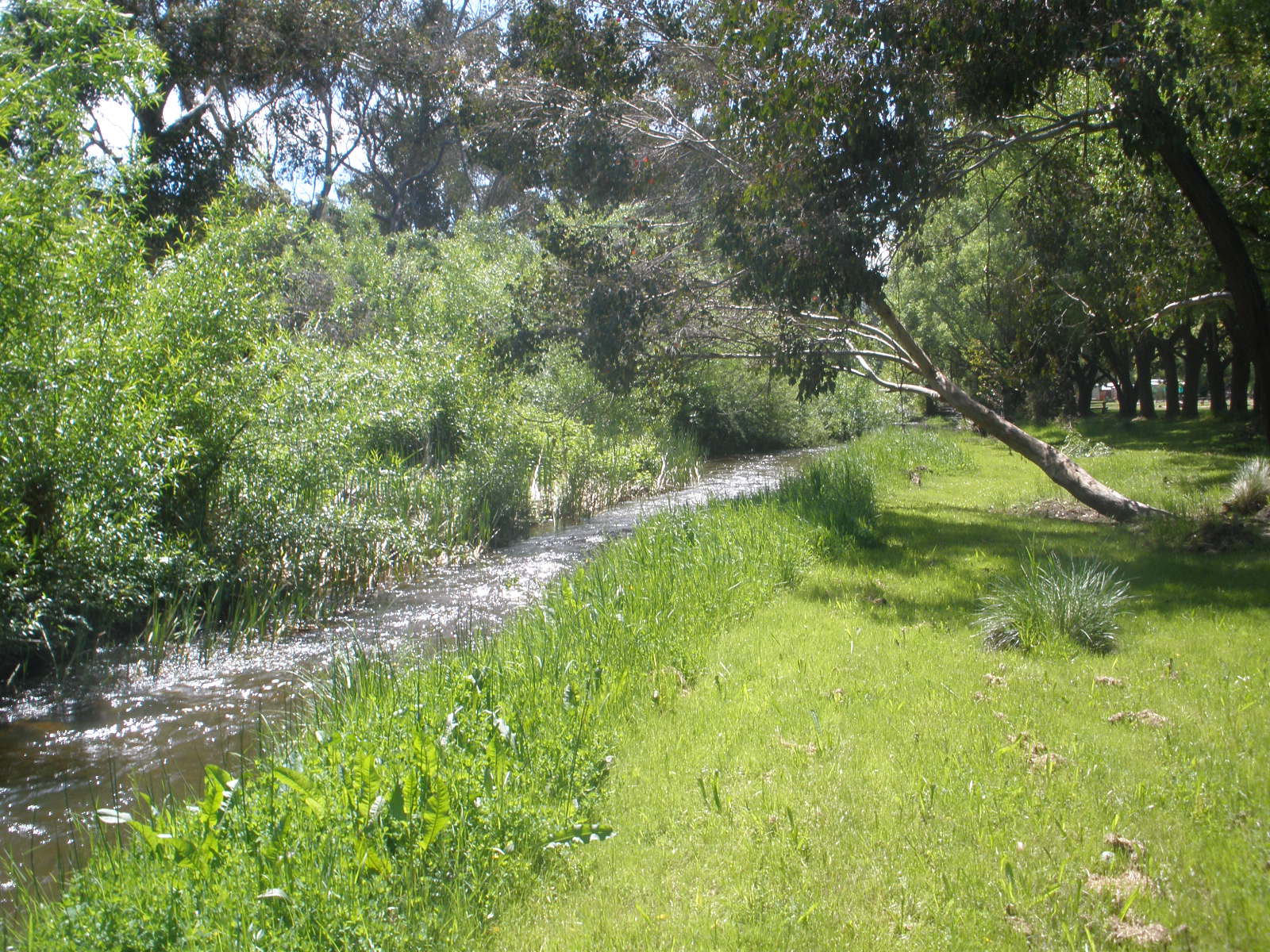
Prior to leaving Bairnsdale, we took the opportunity to drive up to Omeo and revisit some old memories. 33 years ago we took the kids to Omeo, and other Gippsland places,  for their first big camping trip. The campground has changed in many ways, but is still quite recognizable as the one we stayed at. Where once there was a fairly wide and shallow river running beside the park, it has now become so overgrown with weeds that access to the water is almost impossible. Another change is the introduction of power and water poles to each site such that it now resembles every other caravan park. Gone is the rustic rural campground where there were no powered sites and water was carried from the communal tap.
 Omeo Caravan Park
 The Mighty River (now but an overgrown shadow of its former glory)
Shirl finally got a close-up photo of an Echidna
From Bairnsdale we moved to Mallacoota where, after booking into our chosen park, we did a quick drive around to discover the ‘lay of the land’. What we found must rate as one of the largest caravan parks in Australia. This park extends around the foreshore of the entire Mallacoota village – it has numerous ‘personal jetties’ that are rented out to those who are occupying a park site.  Mallacoota Inlet is quite spectacular in appearance in that it has many small sand based islands, together with larger vegetated ones. As low tide arrives, many sand banks are exposed which explains why the place is a mecca for the Flathead and Whiting fisherfolk.
I went out on a charter boat one day and was quite astounded by the vast sea grass beds and the relative ease of getting a few flathead (amazing how easy thing become when you do them the correct way!).  If you have a boat, this is a truly outstanding water way.
This Park extends for .................. ever.

On our last day we drove up to Gypsy Point (about 20km) and went on an eco style boat trip. The ‘Capt” was quite astounding in that he could locate tiny birds and water dragons from far greater distances than we could see. We had trouble seeing the log he was pointing to, let alone the 2 inch long dragon camouflaged upon it. Perhaps the biggest ‘party trick’ was where he fed the sea eagles – spotted a pair up in a dead tree, motored over toward them, grabbed a dead fish from a bucket, grabbed a BIG syringe and began injecting the fish.  When asked by a passenger “what are you injecting into it?”, he replied “Heroin, it keeps them coming back!”.  The reality is that he was injecting air into the fish so that it would better float.
The birds began circling above the boat until he tossed the fish about 5 metres away. The birds were swooping before the fish hit the water, and their attack had pinpoint accuracy and was awesomely spectacular. Something to remember.
 They start here!
and they hit with massive speed, accuracy, and vigour
Thursday was moving day – hitched up in pouring rain, drove off in pouring rain, continued driving in pouring rain until we were we up the climb towards Bombala. We stopped for the night at Nimmitabel (at 1100 metres altitude) – not the warmest location in Australia.  The campground is a self managed council one where you drive in, set up, ring a osted number and a guy pops over to give you the special key code to access the secure water key.
Nimmitabel is a bit sad really. Here we have a very old Aussie town that has some real history, but modern life is killing it. Even the pub has closed, and the one remaining club closes at 6:00pm – no meals!  Apart from having a great (make that a real great) bakery, the town has very little business remaining.
The following morning, Friday 11th, we arrived home after 8 months on the road.
The work of unloading and re-establishing life in a big house has now started.
Thanks to all those who have followed the blog – I’ll do one more post of the basic stats from our trip this year, then it’ll be bye from me, and bye from her, until next March/April when we head off again.