22 August 2011

18th august 2011 - Alice Springs

As promised, it’s been some time since I updated our travels. We’ve gone from Charters Towers to Alice Springs in 18 days, and with lots of fun and excitement along the way.
Perhaps the most interesting thing for us has been that the entire trip has been through country that is entirely different than what we’d imagined. Where we expected almost desert like terrain, we found scrub filled rolling hills, and where we thought we’d be rolling along flat featureless plains, we were in chain after chain of ranges.
After leaving Charters we entered the dinosaur belt. Did you know that the large triangle of country bounded by Hughenden, Richmond and Winton is lauded around the World as one of the great dinosaur centres? It is. Way back when Australia had an inland sea (called Eromanga), Hughenden was on one bank, Richmond in the middle, and Winton in the shallows. For some 40 odd years, fossils have been popping up all around the area, with almost every farmer/grazier/pastoralist fully aware that the next time his shovel or plough hits something; it may well be another great piece of history. Both Hughenden and Richmond have very good museums with real skeletons of dinosaurs and really large fossils.
 I'd hate to walk out of the Hughenden pub with a few beers too many.
 Richmond Dinosaurs went swimming.
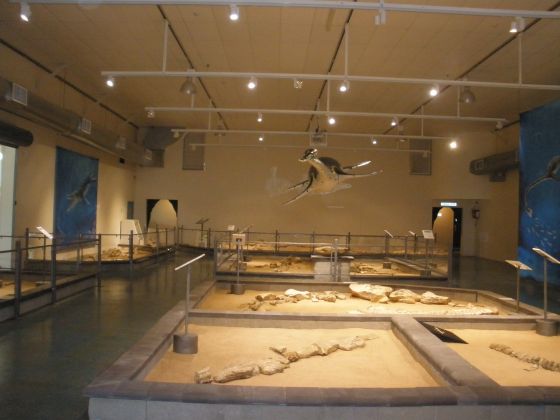
Inside Richmond Museum
After immersing ourselves in ancient history, it was good to move forward to recent stuff at Cloncurry. John Flynn was the father of the Royal Flying Doctor Service (RFDS), and subsequently the School of the Air – not a bad CV. Cloncurry was where all this took place, as well as it being the landing place of the first Qantas flight. The juxtaposition of this item and the RFDS are not unrelated as Flynn witnessed what Qantas did, and his lateral thinking went into overdrive.
Along this section of the road was where we first encountered our first road trains: all 53+ metres and 120 tonnes of them. They come in all sorts of combinations such as the common 3 trailers, or the 2 trailers and a B-Double, or a B-Double with 2 trailers behind, or 2 B-Doubles.  And once you cross into the Northern Territory you find that they hook 3 B-Doubles together.

After 4 nights in Mt Isa, we were getting ready to leave when we had a little mishap – to be honest; it was a bloody big stuff up.  When rolling the awning up, we decided to clean it and the only way that I could reach it was to drop the tailgate of the Cruiser to use as a platform. All went well until the last section, when Shirl went inside the van, and in my impatience, I decided (spur of the moment thing) to reverse up without her guidance – jumped in the car, didn’t remove thongs, open door and lean out looking backwards, foot slips out of thong, off brake onto accelerator and BANG. Into side of van goes the tailgate and breaks van door plus tailgate.
The park owner gave us the name of the local van repair guy who comes around and repairs door – insurance says that they will consider it a temp ‘make safe’ repair until we get back home. We checked with local panel beaters and find that they can’t get a new tailgate for 4 to 6 weeks – bugger. Further checking reveals that there are nil, none, nought second hand tailgates in Mt Isa, and the panel beaters are not prepared to ‘chase’ one down through Darwin etc – double bugger.  However, a saving angel appeared in the guise of the guy on the adjoining site. Their son works at a Toyota dealer near Brisbane, and could source a good unit down there. Even better was that he was about to drive up to Mt Isa (to see his new nephew) in two days time. This guy is our new hero. The end result was that we did the deal and our new second hand tailgate, which the insurance people agreed would also be regarded as a temp ‘make safe’ until we get home, arrived and was fitted.
Thus we ended up staying in Mt Isa for 11 nights rather than the original plan of 5 nights and this gave us the opportunity to go to the Mt Isa Rodeo which is reputed to be the biggest in the country. It was funny to go to an event where everyone wore cowboy hats, jeans, country shirts, and riding boots. The blokes wore similar. The award for “Mr Kool” goes to the bloke in the Steer Wresting who came out of the gate at a zillion kph, jumped from his horse onto the back of the racing steer, slid up along the animals back until he could grab the horns, dropped down as he twisted the beast’s head until both were on the ground, then manhandled the horns until the steer was upside down while the bloke tied it’s legs together. Not so special you think? They all do that. But how many do it without dislodging their hat, and whilst wearing their designer sunnies? (sorry, no photo)
 Note that the horse does most of the work.


We also did an underground mine tour which opened our eyes to the noise down there. Huge machines do most of the work these days, and as each section is worked out, they just ‘bury’ these monsters because it’s cheaper to buy a new one, than dismantle and recover the old.
The future for the mine appears to be interesting – they are currently working on the business plan that they will gradually close the underground workings down over the next six years, and replace it with the World’s biggest superpit at 16 km long and ??? deep.  The smelter is already being shut down. I guess that eventually they’ll dig deep enough to find a lot of old buried scrap metal!
The transit from QLD to NT is “interesting” but only if you like 630 km of almost straight road (one section went 63 km without even a hint of a bend). The vegetation changed every once in a while, but soon went back to one of the earlier 2 or 3 types that had passed before. We stopped at Camooweal for the night, and after parking the van we went for a walk around the town – this took about 5 minutes. Night out here on the Barkly is dark – very dark. I understand that the locals walk around with their eyes closed because they can see better that way.

 Peak Hour at Camooweal
Other than Camooweal, the only other sign of habitation in all that distance is the pub and roadhouse at Barkly Tableland. Diesel is $2:20 per litre so we didn’t stop. However, we should be fair and admit that once past Tennant creek and heading south, the road is dominated by long stretches of 40 odd km without a hint of bends. When they do come, the bends are so gentle that you almost miss ‘em.

Barkly Highway

More Barkly Highway views


Speed Limit? what Speed Limit?

Tennant Creek has some nice little items that are worth a quick look. The old telegraph station is the best preserved of all the original 11 between Adelaide and Darwin – makes you think just how lonely and isolated the operators were. Such pioneer buildings also highlight how we should be constructing houses, as the original house was built of local stones (300mm thick), with 2 mtr wide verandahs on all walls. Step into the house and the temperature drops 10 deg.


Given that Tennant really took off when they made the last significant gold strike in Australia, it’s no surprise to find one of the major tourists thingy’s is the old gold battery. The photo shows that health & safety weren’t such big items back then.

The caravan park at Tennant has a campfire with a local bush poet each night. Bush tucker is the campfire menu and yes, we did actually eat freshly cooked witchetty grubs which we found quite tasty (like freshly roasted peanuts).
Just over 100 km south of Tennant are the amazing Devils Marbles. We had always thought that they covered just a few house blocks in area. Boy, were we wrong, they seem to go on forever.  Spent some time looking and marvelling about how they could retain their balance for so many centuries, while we did the touristy thing and set up some posed photos.


We spent the night at the UFO capital of Australia; Wycliffe Well. The caravan park is the only thing there, and given that it sells alcohol, the evening ‘entertainment’ put on by the locals is something that all the park guests would’ve preferred not to have. It seems that banning alcohol in the communities produces other consequences such as the grog being consumed at the point of sale – and then driving home!!!!  Again, when the sun goes down and darkness falls, it does so with a vengeance – dark so dark that you can’t see the locals at all.
I couldn’t resist a photo of the Hulk when the army convoy rolled in to fill up. Maybe I should start a ‘caption’ competition.


After leaving Wycliffe we headed to Alice Springs where we will stay for 10 nights. On the way we trundled through a roadhouse call Aileron and found that they have these giant statues of 10 metre tall aboriginal folk – very impressive.


04 August 2011

29th July 2011 - Charters Towers

Okay, I’m sure that most of you have worked out that there is something funny about the date that this has been posted – I write it using “Word” (lot easier to edit), then download the photos, then go online and copy it across. All of that happened, except the last step. I Didn’t realise until 5 days later. Sorry.
Since our last post we have had 4 nights in Townsville and six in Charters Towers. Townsville was, as expected, a very large country city with numerous shopping malls with everything so standardised that you wouldn’t know if you were in Perth, Hobart, Canberra, or Cairns. The waterfront area has been recently re-built and it is quite marvellous. Locally, it is known as ‘The Strand’ and truly deserves that elegant title. Great areas for kids, teens and adults with a glorious view to Magnetic Island are all built into the design.  Another area that former residents may not recognise is Palmer St on the south side – it now rivals any trendy yuppy cafe latte street in the country.
Our van site adjoined a Sizzler’s outlet, and we couldn’t resist a couple of visits (Shirl had Ribs and I had Steak & Prawns). We decided that we really miss Sizzler’s now that they aren’t in Canberra.
On our run up to Charters Towers on Sunday we came across our first road train. I noticed him slowly catching me so I backed off a bit to let him past and was amazed to find that he was hauling a dog trailer plus a B double: 4 trailers in all. I guess he was empty because he was certainly moving it along.
Charters Towers was once the 2nd largest city in Qld and even had its own stock exchange: these days it is about 8,000 people. There are many old buildings that have been restored and the entire commercial/shopping area looks great, and there are many “touristy” things to see and do. A general theme of some has to do with ‘Ghosts of Gold’ where they have various means to have 3D or ephemeral ghostly images pop out and tell their story.
 the former Stock Exchange, and Australasian Bank.
Not all Target stores are over 100 years old. All original inside.
 Shirl finally go to see a cattle auction, and was somewhat underwhelmed. Some bloke that she couldn’t understand, yelling at a heap of other blokes who didn’t seem to move – then another bloke painted a coloured letter on the rumps of the cattle, while all the other blokes wandered along to the next pen. More fun watching the horsemen move the cattle in, out, along, and into different pens.

I know that it may sound just as boring, but we spent a bit of time wandering around the local historical cemetery (which is also the current one), and discovered some interesting items. A bloke was killed way back in 1904 when he fell in between two railway trucks and was run over. He was buried in section 4, 6 & 9.  Another was working at the bottom of a mine shaft, when a hopper fell 900 feet and squashed him. His grave occupied all of section 24.
Queensland’s last official bushranger is buried here – he and his brother were both convicted with the brother being hanged, and this guy got ‘life’ only to be released after 14 years. He lived for another 24 years!
And poor Bridget Clancy, here she was enjoying a bit of slap and tickle with her sisters hubby when the so and so dies. Rotten sod he was. Bridget was so upset that she goes to the pharmacy and gets some strychnine “for her sick dog” and tops herself! What was she thinking? She was a good looking 30 year old who owned a pub – I repeat, she owned a pub. Surely a line of eligible men were all hers for the asking.

It offered some amusement when we found that when the gold was discovered, the authorities decided to establish the town at what is now an outer suburb of Charters Towers (because that was where the nearest water flowed) and called it Millchester, but the miners said “up yours”, or something similar, and set up their own town closer to the gold. A number of other mining towns have such actions written into their history – West Wyalong vs Wyalong in NSW, Yerranderie in the backwater area of Warragamba Dam are but two that spring to mind. You have to love the larrikin Aussie attitude, dontcha?
The official gold stamp & mill were established at Millchester and this mill still exists. It is not in full working condition, but it did continue working up until 1973. The tour of the complex explained the very detailed process needed to extract the gold dust from the ore. We were fascinated to the extreme. 

The School of Distance Education is another place that we visited and listened to a class of Yr 1 & 2s being taught by telephone. Gone are the days of radio, the system now works over the telephone network and uses computers (doesn’t everything?). Again, the process involved to get books, reading info, homework, and parent guidance out to the students homes is amazing. We were also intrigued to learn that the students include those on outlaying properties (many hundreds of kilometres away), students whose parents chose home schooling, students who have been subjected to school bullying, as well as overseas youngsters.
Yesterday we drove over to a small gold mining town called Ravenswood. This was Queensland’s first inland town in 1869 and remained a large and vibrant gold town until WW1. Interesting to see photos taken in the early 1900s and compare with today. Many very large and substantial buildings have simply totally disappeared with not even a foundation left. There remains about a half dozen decent buildings with two of them being pubs. Fascinating fact as to the quality of the gold at both Ravenswood and Charters – it was, and remains the highest grade ore in Australia at twice the grade of any Victorian field, and 75% higher than WA Kalgoolie.  Ravenswood already has a big hole being dug right on the edge of the town, and I’ll bet my kids will see another “Superpit” developed at both these Qld towns – pity about the actual towns, because the richest seams are under them.
 They don't make pubs like this anymore
 I had to do it - my artistic streak just bubbles over sometimes.
 Post office - tough times mean that you just need to diversify into other fields.
Parked out front of the other pub - I think the drivers are on a bit of a bender.
Mr & Mrs Butler raised 21 kids in this tin house. They lived in it until 1981


Off to Hughenden tomorrow, then Richmond, Cloncurry, Mt Isa, Camooweal, Barkley Homestead, Tennent Ck, Devils Marbles, Ti Tree, and finally we will get to Alice Springs.   Since most of these places will only delay us for a single night (Mt Isa will be 5 nights), we won’t be posting another update for about another fortnight or so.


29 July 2011

20th July 2011 - Mission Beach

Co-incidence or what!  From the time that we started caravanning, we have followed the blog of a Melbourne couple, Mike & Minette. They sold their house and have been on the road full time for nearly 3 years, and every step of the way Min has entertained and delighted us. They'd been camped at Exmouth & Coral Bay in West Oz for some time, and then we followed them as they rather quickly moved up the coast to Broome (very short stop), and across to Darwin. Meanwhile, we were moving up the east coast and around far north Qld before setting up at Mission Beach. What do we find on day two – the fellow two sites from us was working on his boat, and I struck up a conversation with him. Wheels started to churn; facts seemed to be meshing; his name was Mike, he had a boat, he drove a Toyota LC200, he had a South African accent. Yep, it was they. Hopefully we’ll bump into them again, and share another drink or two. 

The entire ‘Cassowary Coast’ is certainly showing the aftermath of cyclone Yasi. Where once there was thick and lush rainforest, there are now many fallen or bare trees with huge areas that are impenetrable because of the debris.  Dunk Island is but a kilometre or so offshore and suffered the full force of Yasi, is still closed and will remain so for 12 months or more.
Paronella Park (google it) is 20 or so km south of Innisfail and what a magnificent place it is. But, it used to be even better! Cyclone Larry in 2006, then Yasi this year has caused major damage to some buildings. Because of the unique nature these buildings can never be fully restored to what Jose Paronella created all those years ago. If you ever find yourself wondering just what you can achieve, or doubt how much you can do by yourself, visit Paronella. 


Another interesting place is Innisfail. Way back in the early 1900s the town was virtually flattened by a cyclone. The vogue architecture of the era was Art Deco, so many of the new buildings were of that style. Seeing the individual flair that this gave the town, the civic leaders chose to apply pressure to anyone doing a commercial building to use that style. The town now has a specific and definable visual appeal that clearly identifies it as Innisfail. Pity other places didn’t follow and create their own special character.
One of the odd and interesting results of Yasi relates to the amount of damage to the cane crop(s). We did a tour of the Tully sugar mill and were amazed at the range of rubbish that is scooped up by the harvesters – yes, everything including the kitchen sink. It seems that a local was in the process of doing a bit of home renovation and had his new kitchen stored under the carport when Yasi came along and redistributed it into the middle of a nearby cane crop. Come harvest time, it ended up at the mill where the sorting machinery pulled it out and diverted it to the junk bin with all the roof panels, guttering, carports, cycles, and farm machinery.
As we were leaving the mill, our tour guide handed us small packets of “Tully Sugar” with the advice that this was the only way that we could get Tully sugar in Australia!  Tully is now owned by a Chinese Govt company and doesn’t hold a licence to sell within Australia. The entire output is exported to China. 
Mission Beach is a wonder to behold (even in its Yasi modified guise) as it seems to go forever, with each step backed by tropical rainforest or palms, and fronted by an island dotted sea of aquamarine. Typical of Queensland beaches, it is quite shallow and you need to walk out a fair way before you get your bum wet.
Our caravan site is totally surrounded by rainforest that, like all this area, holds small populations of cassowaries.  We had the magical experience of a male and his chick (yep, the female walks out as soon as she lays the egg) visiting the park and just wandering around like a movie star.

Packing up now and moving out to Townsville.

15 July 2011

9th July 2011 - Atherton

After coming to grips with the fact that it was raining – and would continue for some time, we decided that a few rest days would be nice. But who the hell decided that ‘a few days..’ would last for a week?  To be fair, it hasn’t been pouring rain but simply continual relentless gentle rain.  As if that wasn’t enough, the night temperatures dropped so much we needed to put the doona on the bed – 9 degrees one night!
In between showers we managed to visit the Tolga Woodwork Gallery.  As someone who likes to do a bit of woodwork, the quality of the items on display is simply overwhelming. Everything from major furniture pieces to exquisitely small detail ones is presented. I must stop taking Shirl to these sort of places – she just keeps finding more things that she wants me to make (at the moment, my ‘to do’ list is full up until 2087).
There appears to be an innate need among the human race to apply pedantic superlatives to almost everything.  Sport is, perhaps, the most frequently encountered arena where this propensity is displayed.
“Bill Bloggs just bowled the fastest ball ever delivered on a Friday, from the south end of Kickatinalong, within a first class match, and by a left handed bowler shorter than 5 ft 8 inches, to a batsman of greater than 6 foot, etc etc etc”
This human need was brought to mind when we went for a ride on a steam train at Ravenshoe.  Record books show this town as the highest in Qld. However, Tumoulin at the other end of the line, is higher! How so, I hear you ask.  Tumoulin is not a town: only a settlement. Makes you feel a bit ripped off.
 Steam Train at Tumoulin - the highest & wettest thingo in Qld
Queenslands Highest Pub - about 2 metres higher than the one over the road.
But wait, there’s more. Babinda and Tully, on the coast, are the towns that we usually think of when considering which the wettest town in Australia is. Tumoulin is wetter than both, but doesn’t earn a Guernsey because it isn’t a town.
Then we get to waterfalls, of which there is a plethora (like that word?), up here in the tablelands. Every one of them comes with its own superlative – widest, highest, highest dual drop, greatest fall of a single drop within a multiple drop ...... the list continues to expand. The one ultimate fact is that they all look good and for some odd inner tranquillity, they make us feel good as we go ooohhhh, aahhhhh, wow.
Millaa Millaa Falls

Millstream Falls - widest in australia.

Nuts! Everyone knows that Kingaroy grows the majority of Australia’s peanuts – wrong. The Atherton Tablelands has the most acreage of peanuts, however most of them go into peanut butter, peanut oil, flavouring etc, and only a small amount into table nuts. We enjoyed our visit to the peanut place, and expect that the after effects will be with us for a while.
Another thing they do up here is coffee – 90% of the coffee that is grown is Oz, is grown here. We did the taste tour where 21 different coffees, plus 42 chocolates and 3 coffee/chocolate liqueurs are on offer.  It’ll take us a week to come down of our high!
The ‘Coffee Works’ tour includes entry to their museum of the history of coffee. Absolutely amazing the financial impact the coffee trade has had on the growth or decline of nations. Another eye opener was the enormous variety of plungers, percolators, blenders, and machines that have been produced all with the simple purpose of brewing your coffee.
I’m sure that within the local rainforests there are thousands, no make that millions, of strangler figs. When it comes to superlatives, there can be no doubt that the Cathedral Fig, and the Curtain Fig  near Yungaburra are supreme. You can’t help but be gob-smacked by each of these.
Cathedral Fig with Shirl standing inside it.

Curtain Fig - too big to get in a single photo.

Our two weeks at Atherton was a period of go go go – so much to see, so much to do.  The rain slowed us down a bit, but we still seemed to be going somewhere each day. Highly recommended.
Statue at Millaa Millaa - not sure just what he's meant to be doing?

We leave for Mission Beach on Sunday. The road down should be fun given that Atherton is at 750 mtrs, but you then need to climb up to nearly 900 to go through Millaa Millaa before dropping down the Palmerston Highway to Innisfail. It is the easiest of the four roads between the coast and the tablelands. The next one north is the Gillies H’way from Gordonvale to Yungaburra which is quite skinny and goes for over 25 km without a straight bit of road. It’s not super steep, but it doesn’t have any guard rails!

07 July 2011

27th June 2011 - Atherton

We ended our stay at Wonga Beach with another day of ‘Croc spotting” on the Daintree River. As well as the obligatory big monsters, we also spotted a baby (500mm) croc laying on a branch, plus a big python doing similar. The departure point this time was a pontoon near a boat ramp, and the tour guide told us that they had a ‘big fellow’ that had taken up residence under the pontoon! And this was but metres away from all those fisherfolk guys who were paddling around as they launched or retrieved their boats.


Mossman Gorge was another spot we got to. The only regret we had was that our photographic skills weren’t able to do justice to this amazing tropical river gorge. As you wander through the rainforest, accompanied by the sound of the water flowing and rushing across the boulders and rapids of the river is ..... well, it just is! Numerous places to swim, or just to sit and cogitate or ruminate – Ah! Feel the serenity.

Mossman River


Mossman River (2)


walkway thru rainforset

I’d hazard a guess that most Aussies wouldn’t know how important the events of June and July 1770 were to our history. Well, let me enlighten you.

Capt James Cook had finished his explorations at Botany Bay and was sailing up the coast. Somewhere around the Whitsundays (which he named), he realised that he were hemmed in by a very long and large reef – he continued on, looking for a way out. On 11 June, just off Cape tribulation (which he named because that’s where his ‘tribulations’ began), they struck a reef. Oh! Bugger. After throwing everything that they could, the Endeavour floated free on the high tide, but with severe damage. After temporary repairs, they limped north looking for a safe harbour.

Finding the mouth of a river, they weren’t able to enter because of rough weather. Finally - and this is really important – Cook’s journal says that they were forced to WARP their way into safe anchorage. Thus we have absolute proof that Australia was founded by intergalactic travellers. Logic! Capt Kirk had Warp drive: Capt cook had Warp drive. Capt Kirk commanded the Enterprise: Capt Cook commanded the Endeavour. Capt Kirk explored strange lands with animals and plants never seen before: Capt Cook did the same.

After entering the river, which Cook named the Endeavour (the only Australian river that he named), the ship was careened (beached) while repairs were carried out.
Cook Landed Here

So, what did they eat? Fish. Plus a strange animal that they thought the locals were calling Kangaroo, but in reality, it should have been pronounced Gangurru (Gang,gur,u). So, for 240 years we’ve been calling it by the wrong name.

The view from the hill that Cook climbed to look for a route through the reef, is one of the great sights that Australia has to offer. Looking over the river mouth, as well as out to sea, there are many postcards that capture the view, but actually being there at sunset is to really nail it – a memory.
what cook seen from the hill (without the lighthouse)

Endeavour River entry
Sunset from Grassy Hill


We also did what has become a bit of a ritual for us: we visit the local botanical gardens. Firstly, the size and quality of the gardens was way above the size of the town. Secondly, they solved an issue that I have long wondered about – where do they come from (see photo).
But can we get different flavours?

A week at Cooktown is about right unless you wish to travel up to Cape York – Cooktown is only 9,654,493 corrugations away from the Cape. Another iconic 4x4 track is the Bloomfield. Older folk may recall the 70s when the “hippies, greenies, and anyone else who wanted to strip off all their clothes and chain themselves to trees” fought a long, and ultimately fruitless battle to prevent a road being bashed through the Daintree. The track runs for 70km from Cape Trib to near Cooktown and includes one of the ‘must do’ great challenges for heavily laden 4x4s – the hill! Most need low range to climb it in the dry, and recourse to higher powers and gods to do it in the wet.

The Bloomfield did rejuvenate one marvellous old icon – the Lion’s Den Pub, 20km from Cooktown. Way back in the gold mining days, a bloke started up a pub and a tradition. The miners needed a safe place for their funds – the camps were full of thieves and villains so they took to leaving their money at the pub, and used the corrugated tin walls to keep a tally. These days, if you donate to the local rural fire mob, you can add your name. Amazing result – almost every bit of wall and roof is covered. PS: they serve a great lunch.
Love the attitude

We also met one of the most interesting blokes imaginable. Willi runs Guurrbri rock art tours. The tour includes far far more than just looking at a few bits of rock art – Willi also talks about bush tucker, historical movement of aboriginals, relationships between clans and families, plus the spiritual aspect of aboriginal culture.

The great bit is that Willi will change your views and beliefs about the ‘aboriginal’ question. Regardless of you previous views, Willi won’t challenge you, but he will gently and simply explain a few things, not directly, but by way of comparisons with ..... well, with life. And you will come away with a different understanding.

You will change your thoughts, but won’t be able to explain why – you just will.

Left Cooktown on Sunday for Atherton where it started to rain.